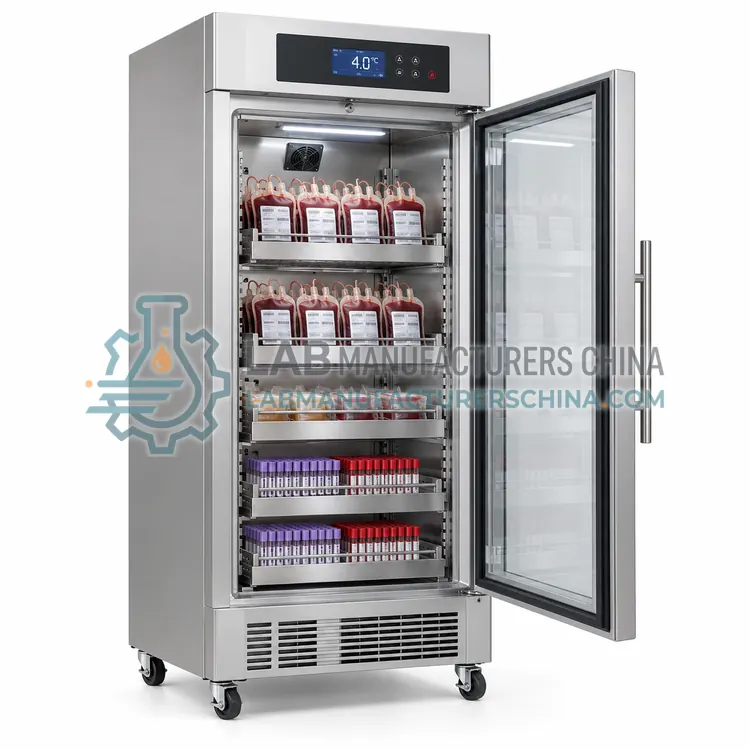
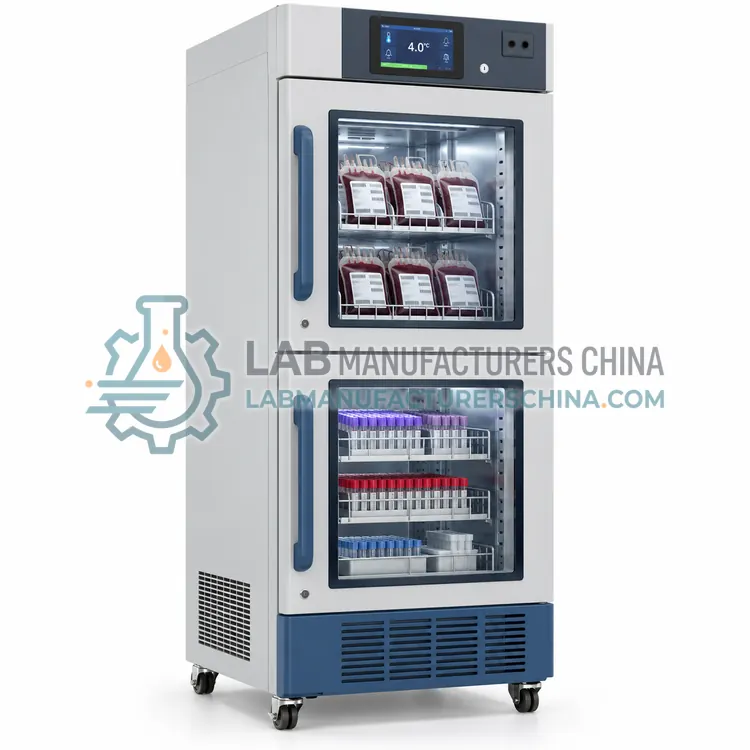
Point-of-Care Blood Storage Refrigerator
床旁输血储血冰箱
- SKU BLO-0005
- Blood Bank Refrigerators
- CE (to be confirmed)
- ISO 13485 (to be confirmed)
- IEC 61010-2-011 test report (to be confirmed)
Price on request — FOB / CIF quoted per order
Prices depend on configuration, quantity and destination port.
Key specifications
| Temperature range | 2–6 °C |
|---|---|
| Capacity | 10–60 red cell units |
| Net capacity | 30–150 L |
| Access control | Key lock, PIN or RFID card |
| Data logging | Wireless or Ethernet, 1–5 min interval |
| Alarms | High/low, door, power failure, battery low |
Request a quote Download brochure · to be provided
By Lab Manufacturers China Technical TeamLast reviewed Standards: AABB Standards for Blood Banks and Transfusion Services, Council of Europe Guide to the Preparation, Use and Quality Assurance of Blood Components, IEC 61010-2-011
What is the Point-of-Care Blood Storage Refrigerator?
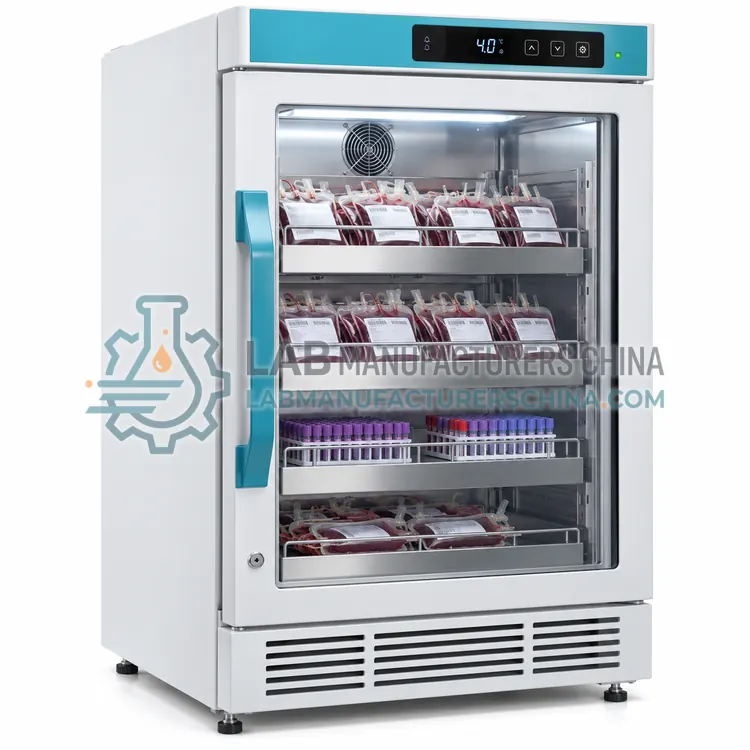
A point-of-care blood storage refrigerator is a small, secured 2–6 °C cabinet placed in an operating theater, emergency department or ward to hold a limited number of red cell units. It provides controlled, traceable storage close to use, with access control and alarms.
What is the Point-of-Care Blood Storage Refrigerator?
A point-of-care blood storage refrigerator is a small, secured 2–6 °C cabinet placed in an operating theater, emergency department or ward to hold a limited number of red cell units. It provides controlled, traceable storage close to use, with access control and alarms.
Overview
This type is designed for satellite locations where blood must be immediately available but a full blood bank is remote. Capacity is usually 10 to 60 units in a compact cabinet with a secure lock, sometimes with card, PIN or RFID access that records who removed which unit. Forced-air cooling and buffer probe monitoring hold 2–6 °C, while a data logger with wireless or network reporting sends excursions to the main transfusion laboratory. Battery backup maintains alarms during power failure, and some models are mounted on wheels to be moved with a clinical team. Units removed from the cabinet must be returned or used within the time limit set by local policy, so access logs and alarms are central to compliance.
How does it work?
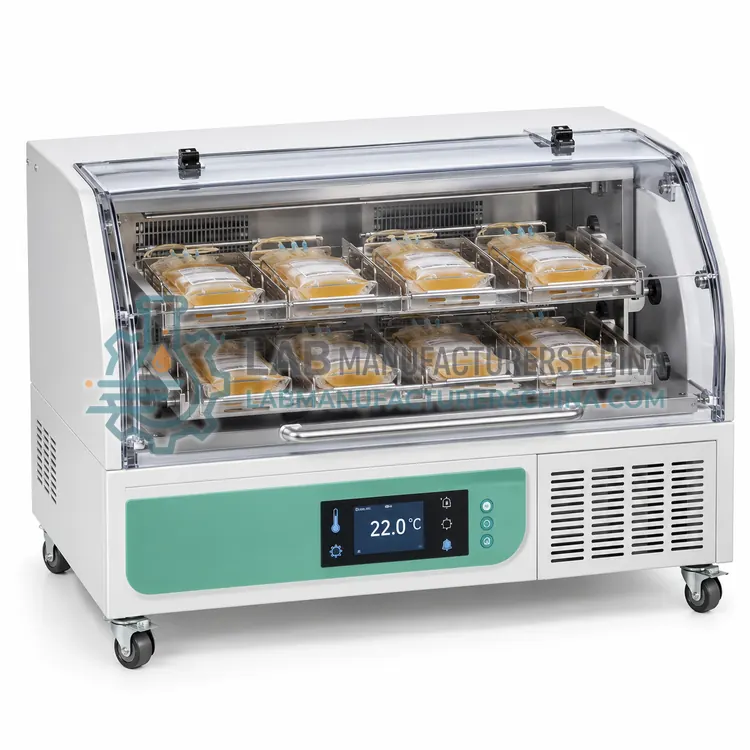
A blood bank refrigerator uses forced-air circulation over an evaporator so that the whole storage volume stays within a narrow band, typically 4 ± 2 °C. A microprocessor controller reads a platinum RTD or thermistor probe, often immersed in a glycol or glycerol buffer bottle that mimics the thermal mass of a blood bag. Independent high/low alarms, a separate recorder probe and a battery-backed alarm circuit are required so an excursion is detected even during mains failure. Door-open and power-failure alarms, sealed glass or insulated doors and an electric defrost cycle limit temperature swings. Platelet units differ: a thermostatically controlled chamber at 22 ± 2 °C holds a flatbed or elliptical agitator that keeps platelets in suspension and gas-exchanging across the bag wall.
What are the key features?
- Compact cabinet for 10–60 units near the patient
- Access control by lock, PIN or card with event log
- Wireless or network temperature reporting to the main laboratory
- Battery-backed alarms and sensor-fault detection
- Optional castors for movement within the clinical area
- Buffer-bottle probe representing blood bag temperature
What are the technical specifications?
A typical point-of-care blood storage refrigerator configuration offers temperature range of 2–6 °C, capacity of 10–60 red cell units, net capacity of 30–150 L, access control of Key lock, PIN or RFID card, data logging of Wireless or Ethernet, 1–5 min interval and alarms of High/low, door, power failure, battery low. Values are indicative of the product class; the exact figures for each configuration are confirmed on the quotation and the calibration documents supplied with the instrument.
Which applications is it used for?
The Point-of-Care Blood Storage Refrigerator is used in operating theater satellite storage, emergency departments, labor and delivery units and remote hospitals and clinics. Across the wider Blood Bank Refrigerators class, laboratories also deploy it for red cell and whole blood storage, platelet storage and agitation and hospital transfusion services.
Which standards and certifications apply?
Relevant standards and methods include AABB Standards for Blood Banks and Transfusion Services, Council of Europe Guide to the Preparation, Use and Quality Assurance of Blood Components, IEC 61010-2-011, IEC 61010-1, IEC 61326-1 and ISO 13485. Certification candidates for this model are CE, ISO 13485 and IEC 61010-2-011 test report; each is to be confirmed for the specific configuration before shipment, and certificates are supplied only where they have been issued.
Place the cabinet away from heat sources and leave the manufacturer's ventilation clearance. Allow the unit to stabilize for 24 hours and run a temperature mapping study, with probes at the corners, center and door shelf, before loading blood. Calibrate probes against a traceable reference at least annually and verify alarms monthly. Clean condensers quarterly and defrost drains as required. Keep a written standard operating procedure for alarm response and a contingency plan for power failure, including transfer to a validated backup unit. Retain temperature records for the period required by the regulator or accreditation body, and never store reagents, food or specimens in a unit designated for blood.
How do I select the right Point-of-Care Blood Storage Refrigerator?
Choose a point-of-care cabinet when blood must be stocked outside the main blood bank and you need traceable access. Specify unit capacity, access method, alarm notification route, battery runtime and mounting. Confirm your policy for returning unused units so that cabinet logging fits the return time limit.
How does it compare with other Blood Bank Refrigerators variants?
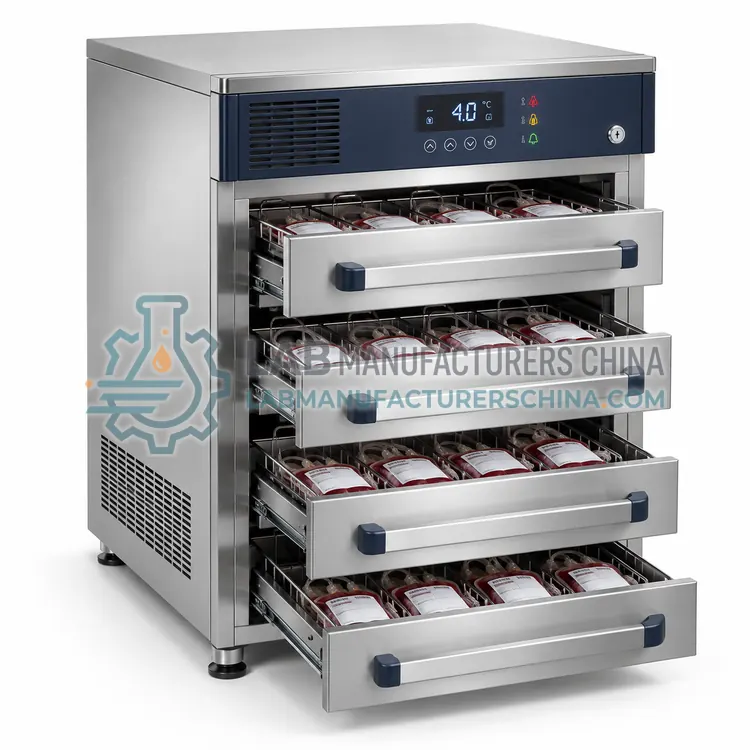
Start with the component you store: red cells and whole blood need 2–6 °C, platelets need 20–24 °C with agitation, and each needs its own cabinet. Next size the capacity in blood units (a 450 mL bag is roughly 0.5 L with racking) and choose drawers or shelves to match workflow. Check the temperature uniformity and recovery after door opening, since these determine real-world compliance. Decide on monitoring: a chart or electronic recorder, independent alarm probe, remote alarm contacts and network logging. A glass door helps inventory checks but increases heat gain. Confirm the refrigerant and ambient class for your climate zone, and whether the site requires battery backup, lockable doors or integration with a hospital monitoring system.
Full specifications
| Temperature range | 2–6 °C |
|---|---|
| Capacity | 10–60 red cell units |
| Net capacity | 30–150 L |
| Access control | Key lock, PIN or RFID card |
| Data logging | Wireless or Ethernet, 1–5 min interval |
| Alarms | High/low, door, power failure, battery low |
| Battery backup | 8–24 h alarm operation |
| Uniformity | ≤ ±2 °C |
| Mobility | Fixed or castor-mounted |
| Power supply | 220 V, 50 Hz |
Indicative values for this product class. Final specifications are confirmed on the quotation and in the calibration documents supplied with the instrument.
Applications
- Operating theater satellite storage
- Emergency departments
- Labor and delivery units
- Remote hospitals and clinics
Key features
- Compact cabinet for 10–60 units near the patient
- Access control by lock, PIN or card with event log
- Wireless or network temperature reporting to the main laboratory
- Battery-backed alarms and sensor-fault detection
- Optional castors for movement within the clinical area
- Buffer-bottle probe representing blood bag temperature
Frequently asked questions about Point-of-Care Blood Storage Refrigerator
It logs temperature at set intervals, alarm events, door openings and, on access-controlled models, the user and time of each access. These records help demonstrate that stored units remained within 2–6 °C and support traceability when units are issued or returned.
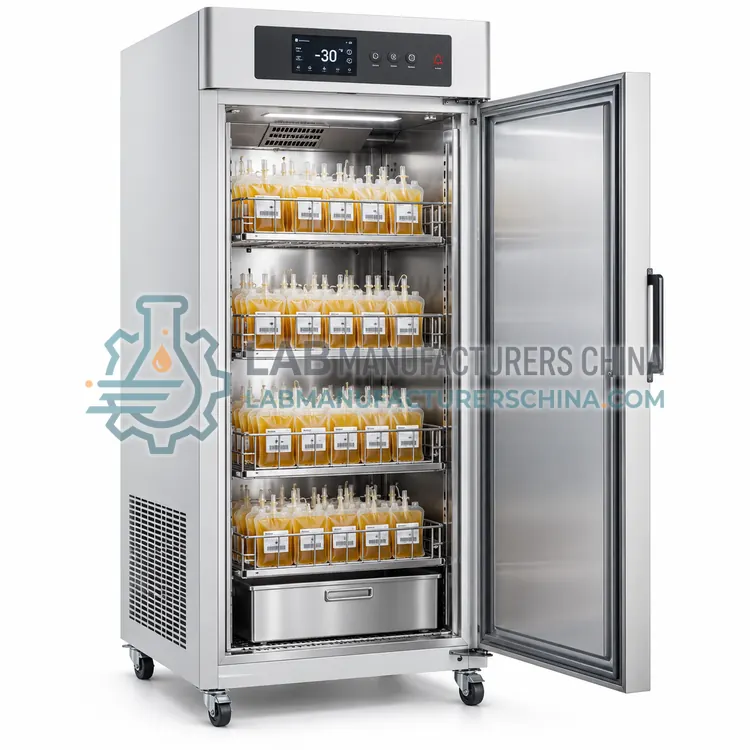
No, not unless designed for it. Platelets need 20–24 °C with agitation and plasma is frozen or thawed under different rules. A 2–6 °C cabinet is for red cells and, where local policy allows, other components requiring refrigeration.
Battery backup in these cabinets is typically sized to keep alarms and logging active for 8–24 hours, not to keep the compressor running. If mains power is lost, the insulated cabinet holds temperature for a limited time, after which units must be moved to validated storage.
Red cells and whole blood are stored at 2–6 °C, and most accreditation standards expect continuous monitoring with alarms set inside that band. Platelets are not refrigerated: they are kept at 20–24 °C with continuous agitation in a separate incubator and normally for up to five to seven days depending on local rules.
It has tighter uniformity (often ±2 °C), a dedicated recorder and alarm probe independent of the control probe, battery-backed alarms, door-open warnings and a glycol probe bottle. Laboratory refrigerators usually lack these controls and are not intended for storing units destined for transfusion.
Probes and recorders are normally calibrated at least once a year against a traceable reference, and after any repair that affects sensors. Alarm function is tested more often, commonly monthly, and temperature mapping is repeated after relocation, major repair or when a risk assessment shows a change in load pattern.
Related models