
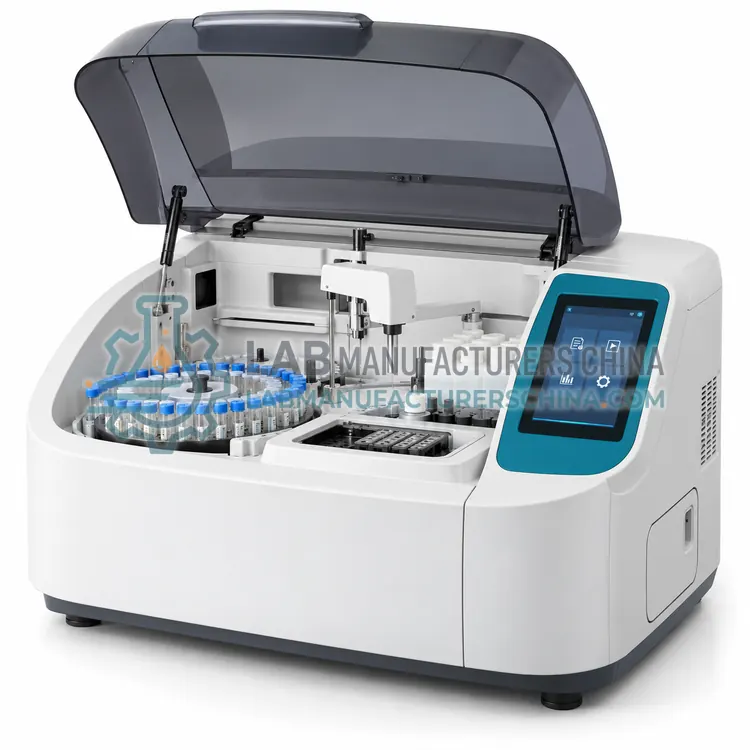
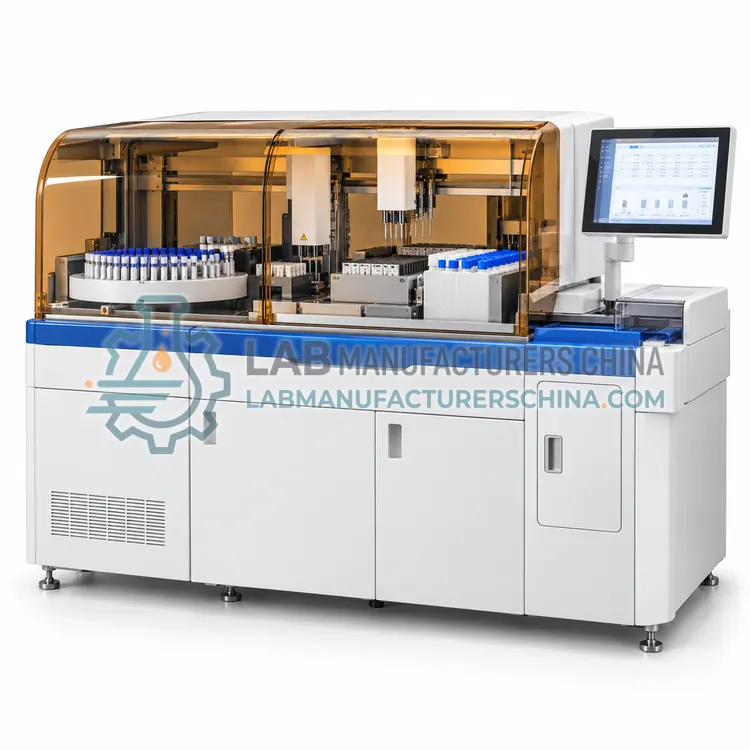
Automated Random-Access Coagulation Analyzer
随机存取全自动凝血分析仪
- SKU ACA-0001
- Automatic Coagulation Analyzers
- CE (to be confirmed)
- ISO 13485 manufacturing (to be confirmed)
- NMPA class II registration (to be confirmed)
Price on request — FOB / CIF quoted per order
Prices depend on configuration, quantity and destination port.
Key specifications
| Throughput | 100–300 clotting tests/h |
|---|---|
| Sample positions | 30–60 positions with continuous access |
| Reagent positions | 15–30 refrigerated positions at 4–10 °C |
| Detection principles | Optical scatter and optional mechanical |
| Incubation temperature | 37 °C ±0.3 °C |
| First-result time | PT about 1–2 min after reagent addition |
Request a quote Download brochure · to be provided
By Lab Manufacturers China Technical TeamLast reviewed Standards: ISO 15189, CLSI H57, CLSI H21
What is the Automated Random-Access Coagulation Analyzer?
A random-access coagulation analyzer accepts any test combination on any sample in any order, with automatic aspiration, incubation and detection. It suits hospital laboratories where routine and urgent hemostasis requests arrive continuously through the day.
What is the Automated Random-Access Coagulation Analyzer?
A random-access coagulation analyzer accepts any test combination on any sample in any order, with automatic aspiration, incubation and detection. It suits hospital laboratories where routine and urgent hemostasis requests arrive continuously through the day.
Overview
The analyzer holds sample tubes in racks or a carousel and reagent in cooled positions, aspirates both into a reaction cuvette and detects clot formation optically or mechanically. Because samples are processed in the order they are received rather than in batches, urgent requests do not wait for a batch to fill, and the software can prioritise STAT tubes automatically. Typical throughput is 100 to 300 clotting tests per hour, with reagent positions for fifteen to thirty assays, and reflex rules such as automatic dilution and rerun for out-of-range results. Calibration curves are stored per reagent lot, control results are plotted on Levey-Jennings charts, and result transmission uses HL7 or ASTM, with full traceability of reagent lot, curve and operator for each report.
How does it work?
An automatic analyzer moves plasma from a sample tube to a reaction cuvette, adds reagent from a cooled position, incubates at 37 degrees Celsius and starts the measurement. Detection may be optical, using the change in light scatter or turbidity as fibrin forms; mechanical or magnetic, following the movement of a ball; or chromogenic, measuring the colour released from a synthetic substrate at 405 nanometers. Immunoturbidimetric channels measure light scattered by antigen-antibody complexes for assays such as D-dimer. The software applies the stored calibration for each reagent lot, calculates ratios and international normalised ratios, applies reflex rules such as automatic repeat at a dilution, and flags results for review. Random access allows any test combination on any sample, and STAT samples are given priority so that emergency results are not delayed by routine batches.
What are the key features?
- Random access with any test combination in any order
- Automatic STAT prioritisation without batching delays
- Optical or mechanical clot detection in one platform
- Stored calibration curves per reagent lot
- Reflex rules for automatic dilution and repeat testing
- Full traceability of reagent lot, curve and operator
What are the technical specifications?
A typical automated random-access coagulation analyzer configuration offers throughput of 100–300 clotting tests/h, sample positions of 30–60 positions with continuous access, reagent positions of 15–30 refrigerated positions at 4–10 °C, detection principles of Optical scatter and optional mechanical, incubation temperature of 37 °C ±0.3 °C and first-result time of PT about 1–2 min after reagent addition. Values are indicative of the product class; the exact figures for each configuration are confirmed on the quotation and the calibration documents supplied with the instrument.
Which applications is it used for?
The Automated Random-Access Coagulation Analyzer is used in hospital routine hemostasis testing, emergency department coagulation requests, anticoagulation clinic INR monitoring and pre-operative screening. Across the wider Automatic Coagulation Analyzers class, laboratories also deploy it for hospital routine and emergency hemostasis testing, anticoagulation monitoring and dosing and pre-operative and bleeding disorder assessment.
Which standards and certifications apply?
Relevant standards and methods include ISO 15189, CLSI H57, CLSI H21, CLSI EP05, CLSI EP15, IEC 61010-1 and IEC 61010-2-101. Certification candidates for this model are CE, ISO 13485 manufacturing and NMPA class II registration; each is to be confirmed for the specific configuration before shipment, and certificates are supplied only where they have been issued.
Install the analyzer on a stable bench or floor position with controlled temperature, a grounded power supply and space for reagent and waste containers, and verify performance at installation with precision, linearity and method comparison studies for every assay reported. Daily work includes running normal and abnormal control plasma, checking reagent and cuvette status and reviewing calibration validity. Optical and mechanical detection systems need periodic cleaning and mechanical alignment checks, and the sample and reagent probes require regular decontamination. Because pre-analytical variables strongly influence coagulation results, the laboratory should monitor tube fill, transport time and centrifugation parameters as part of quality management, and participate in external quality assessment for all reported assays.
How do I select the right Automated Random-Access Coagulation Analyzer?
Specify this variant when requests arrive continuously and turnaround time for urgent samples matters. In the RFQ state the number of assays to be held onboard, daily and peak test volume, the required first-result time for PT and APTT, the reflex rules you need, and whether cap piercing is required for biosafety.
How does it compare with other Automatic Coagulation Analyzers variants?
Match the instrument to your workload and menu. A benchtop analyzer with two to six reagent positions suits a laboratory reporting one hundred to three hundred tests per day, while high-throughput models with multiple reagent carousels are needed above about five hundred tests. Check which detection principles are available, because chromogenic and immunoturbidimetric assays require additional channels and reagents, and check whether cap piercing is needed for biosafety. Consider the sample volume for pediatric tubes, reagent onboard capacity and refrigeration, STAT handling and first-result time, reflex rules such as automatic dilution, and the availability of application support and calibrators. Confirm LIS connectivity and the traceability features, including lot, curve and operator records required for accreditation.
Full specifications
| Throughput | 100–300 clotting tests/h |
|---|---|
| Sample positions | 30–60 positions with continuous access |
| Reagent positions | 15–30 refrigerated positions at 4–10 °C |
| Detection principles | Optical scatter and optional mechanical |
| Incubation temperature | 37 °C ±0.3 °C |
| First-result time | PT about 1–2 min after reagent addition |
| Reflex testing | Automatic dilution, repeat and reflex panels |
| Data storage | 10,000 results with curves and control charts |
| Interfaces | LAN with HL7 or ASTM two-way communication |
Indicative values for this product class. Final specifications are confirmed on the quotation and in the calibration documents supplied with the instrument.
Applications
- Hospital routine hemostasis testing
- Emergency department coagulation requests
- Anticoagulation clinic INR monitoring
- Pre-operative screening
Key features
- Random access with any test combination in any order
- Automatic STAT prioritisation without batching delays
- Optical or mechanical clot detection in one platform
- Stored calibration curves per reagent lot
- Reflex rules for automatic dilution and repeat testing
- Full traceability of reagent lot, curve and operator
Frequently asked questions about Automated Random-Access Coagulation Analyzer
STAT tubes are identified by barcode or by their rack position and are given priority in the scheduling queue, so they are aspirated before routine samples already waiting. Confirm the maximum delay for a STAT sample when a long assay such as D-dimer is running.
Only if it includes a photometer that reads at the required wavelengths, usually 405 nanometers for chromogenic substrates, and the software supports kinetic measurement and the corresponding calibration models. Confirm the validated assay list rather than assuming that all hemostasis tests can run.
Underfilled citrate tubes, delayed processing, hemolyzed or lipemic samples, incorrect reagent reconstitution and residual heparin from a line flush are the usual causes. Erroneous results are best detected through control results, sample inspection and communication with clinical staff about line draws.
Each reagent lot is calibrated when first used, and most clotting time curves then remain valid for the life of the lot if control results stay within limits. Chromogenic and immunoturbidimetric assays usually need more frequent calibration, which the manufacturer instructions specify.
An automatic analyzer aspirates samples and reagents, incubates, detects the endpoint and reports results without manual pipetting, and it can run samples in any order. A semi-automatic instrument requires the operator to add sample and reagent but performs incubation and detection itself.
Optical detection is the most common and supports both clot-based and chromogenic assays but is affected by icterus, hemolysis and lipemia. Mechanical detection is largely free of these interferences, and many platforms combine both principles to offer flexibility for different sample types.
Clotting time tests such as PT and APTT usually report within one to five minutes of reagent addition, with total turnaround from sample receipt of fifteen to thirty minutes. Immunoturbidimetric assays such as D-dimer take longer, often fifteen to forty minutes depending on the platform.
Related models
Automated Coagulation Analyzer with Immunoturbidimetric Assays
带免疫比浊项目的全自动凝血分析仪
- CE (to be confirmed)
- +2
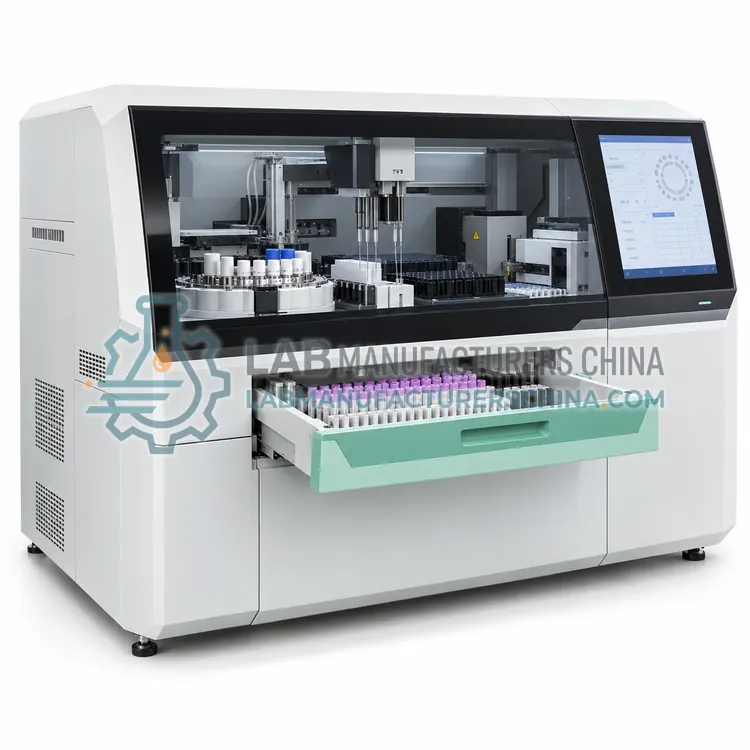
Fully Automated Coagulation Analyzer with Cap-Piercing Autoloader
带穿刺开盖进样器的全自动凝血分析仪
- CE (to be confirmed)
- +2
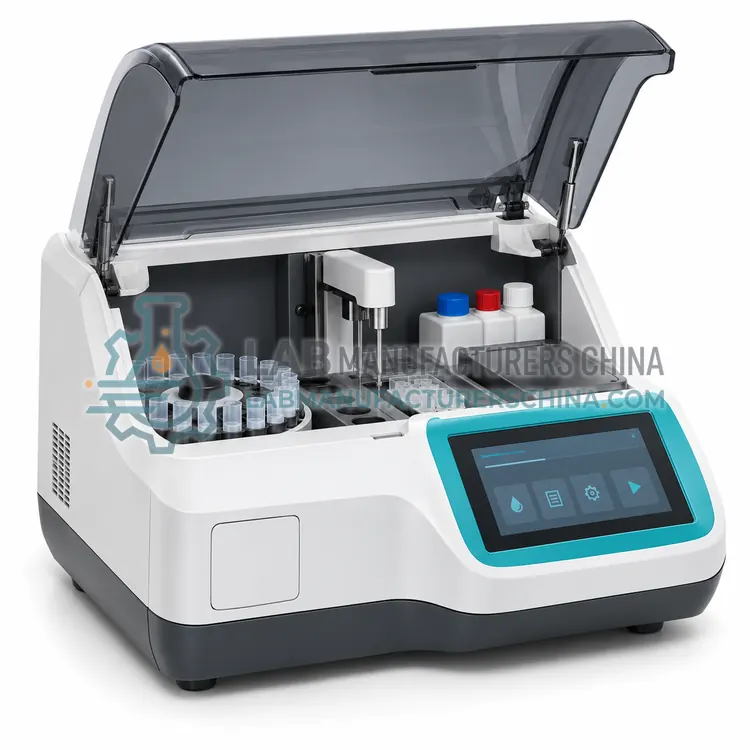
Semi-Automatic Coagulation Analyzer with Mechanical Clot Detection
机械凝固检测半自动凝血分析仪
- CE (to be confirmed)
- +2