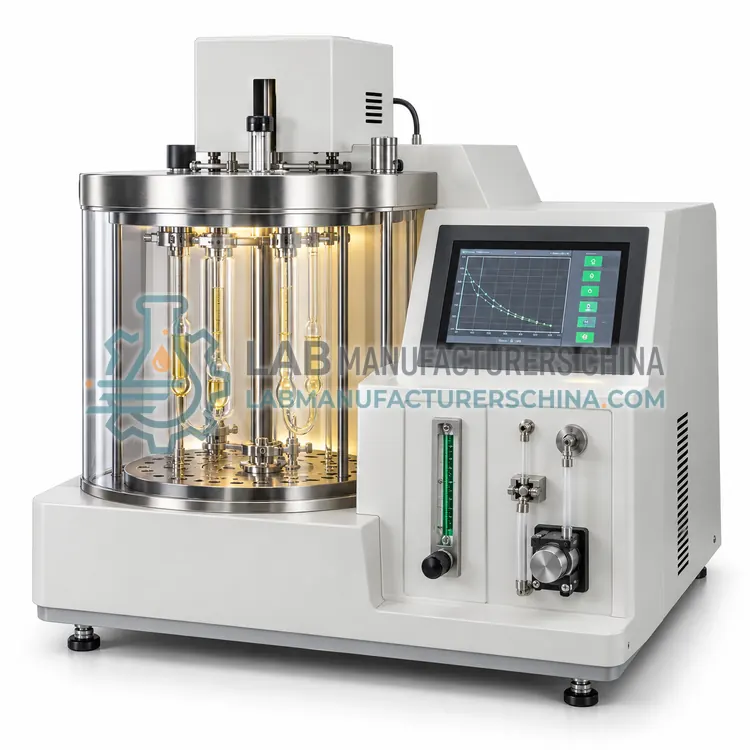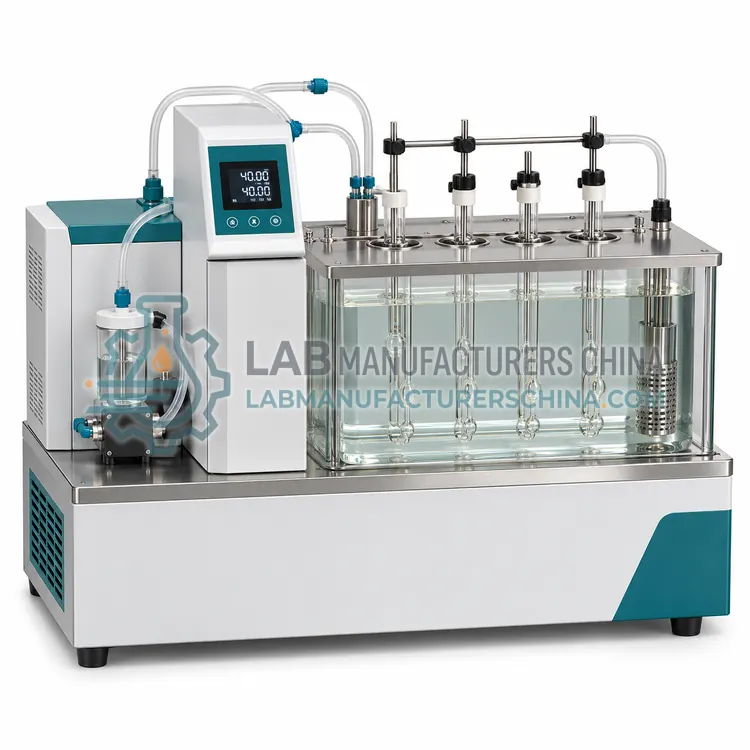
Manual Kinematic Viscosity Bath with Glass Capillary Viscometers
手动运动黏度恒温浴及玻璃毛细管黏度计
- CE (to be confirmed)
- +1
Welcome to Lab Manufacturers China — laboratory instruments direct from a Chinese manufacturer
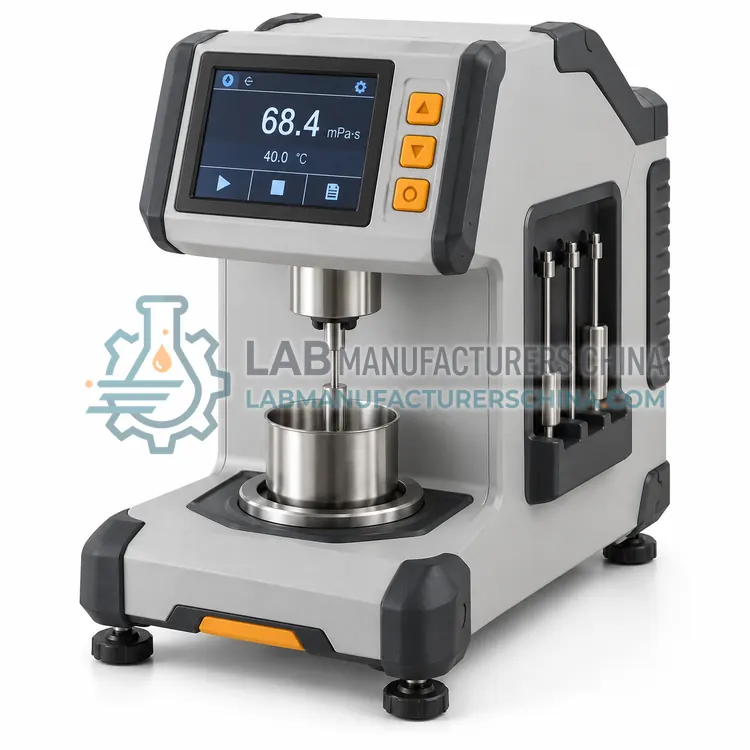
微型旋转黏度计
Price on request — FOB / CIF quoted per order
Prices depend on configuration, quantity and destination port.
| Test temperature range | −40 to −10 °C |
|---|---|
| Cooling profile | Programmable, ≈ 18 h cycle |
| Temperature accuracy | ± 0.1 °C |
| Number of cells | 6–9 |
| Sample volume per cell | ≈ 10 mL |
| Apparent viscosity range | ≈ 1,000–400,000 mPa·s |
By Lab Manufacturers China Technical TeamLast reviewed Standards: ASTM D445, ISO 3104, ASTM D2270
A mini-rotary viscometer measures low-temperature pumpability of engine oil by applying slow cooling and then low shear to the sample. It reports yield stress and apparent viscosity at −20 to −40 °C, helping identify oils that may gel and starve an engine of lubricant under ASTM D4684.
A mini-rotary viscometer measures low-temperature pumpability of engine oil by applying slow cooling and then low shear to the sample. It reports yield stress and apparent viscosity at −20 to −40 °C, helping identify oils that may gel and starve an engine of lubricant under ASTM D4684.
Several small cells each hold about 10 mL of sample and a rotor connected to a torque-measuring spindle. The cells are cooled in a programmable bath following a slow, defined temperature profile over roughly 18 hours, which lets wax or gel structures form. After the soak period, the instrument applies a set of weights to the rotor to measure yield stress, then a constant shear to determine apparent viscosity. Because the cooling profile is part of the method, programmable control and accurate temperature measurement within ± 0.1 °C are essential. Results show whether oil can be pumped to the pickup at cold temperature. Units commonly hold 6 to 9 cells, allowing batch testing overnight.
Viscosity is the resistance of a fluid to shear. Capillary viscometers measure the time for a fixed volume of oil to flow by gravity through a calibrated tube at constant temperature, and kinematic viscosity equals flow time multiplied by the tube constant. Rotational instruments measure the torque needed to turn a spindle or cup in the sample at a known speed, giving dynamic viscosity. Stabinger-type cells combine a rotating tube with a floating inner rotor and a density measurement to give both dynamic and kinematic values. Cold cranking and mini-rotary tests apply defined shear or cooling profiles to simulate cold-start behavior, while tapered bearing simulators apply very high shear at 150 °C to measure HTHS viscosity. Precise temperature control is the dominant error source in every method.
A typical mini-rotary viscometer configuration offers test temperature range of −40 to −10 °C, cooling profile of Programmable, ≈ 18 h cycle, temperature accuracy of ± 0.1 °C, number of cells of 6–9, sample volume per cell of ≈ 10 mL and apparent viscosity range of ≈ 1,000–400,000 mPa·s. Values are indicative of the product class; the exact figures for each configuration are confirmed on the quotation and the calibration documents supplied with the instrument.
The Mini-Rotary Viscometer is used in engine oil pumpability testing, SAE J300 W-grade certification and cold-flow additive development. Across the wider Viscosity Testing class, laboratories also deploy it for lubricant grading (ISO VG, SAE), engine oil qualification and base oil and additive blending.
Relevant standards and methods include ASTM D445, ISO 3104, ASTM D2270, ASTM D5293, ASTM D4684, ASTM D4683 and ASTM D7042. Certification candidates for this model are CE and ISO 9001 manufacturing; each is to be confirmed for the specific configuration before shipment, and certificates are supplied only where they have been issued.
Install viscosity equipment on a vibration-free bench away from drafts and direct sun. Calibrate viscometers with certified reference oils traceable to national standards, and verify thermometer or temperature probe accuracy at each test temperature. Glass capillaries must be cleaned thoroughly, since residue changes flow time, and inspected for chips. Replace circulating bath fluid on schedule and check stirring for uniformity. Record the capillary constants and requalify tubes periodically. Automatic units need periodic verification of sensors and pumps. Follow the standard's precision statement when deciding whether duplicate runs agree, and keep records of reference oil checks to support accreditation such as ISO/IEC 17025.
Select a mini-rotary viscometer with a cold cranking simulator for complete SAE J300 W-grade qualification of engine oils. It is not needed for industrial oils. Specify number of cells, cooling programs, temperature range, coolant bath type, data export and the torque calibration procedure.
Choose the variant from the viscosity parameter that the specification requires. Kinematic viscosity at 40 and 100 °C for industrial and engine oil grading points to a capillary bath, either manual for low volume or automatic for high throughput. Laboratories needing small samples, wide range and density in one run suit a Stabinger viscometer. Engine oil qualification to SAE J300 also needs cold cranking, mini-rotary and high-temperature high-shear instruments. Compare temperature stability, sample volume, number of tubes, cleaning approach and whether the instrument meets the method's dimensional and precision requirements. Consider operator time, since automatic units reduce cleaning and timing errors. For the RFQ, state the methods, temperature range, expected viscosity range, daily sample count and report format.
| Test temperature range | −40 to −10 °C |
|---|---|
| Cooling profile | Programmable, ≈ 18 h cycle |
| Temperature accuracy | ± 0.1 °C |
| Number of cells | 6–9 |
| Sample volume per cell | ≈ 10 mL |
| Apparent viscosity range | ≈ 1,000–400,000 mPa·s |
| Yield stress detection | Below/above 35 Pa |
| Cooling system | Refrigerated circulating bath |
| Applicable method | ASTM D4684 |
Indicative values for this product class. Final specifications are confirmed on the quotation and in the calibration documents supplied with the instrument.
Yield stress is the minimum stress needed to make gelled oil begin to flow at low temperature. A result above the limit, often 35 Pa, indicates possible loss of pumpability in an engine.
The slow controlled cooling lets wax crystals and gels develop as they would during an extended cold soak. A faster profile would miss those structures and overestimate pumpability.
Yes, up to the number of cells, but each run follows the same temperature program. Group samples that require the same test temperature, and record the cell position for each oil.
Dynamic viscosity is the internal resistance to shear, measured in mPa·s. Kinematic viscosity is dynamic viscosity divided by density, measured in mm²/s. Capillary methods give kinematic values, while rotational methods give dynamic values.
Industrial and engine oils are commonly measured at 40 °C and 100 °C for grade assignment and viscosity index. Low-temperature methods run from about −40 to 0 °C, and HTHS viscosity is measured at 150 °C.
Viscosity index is calculated from kinematic viscosities at 40 °C and 100 °C using the procedure in ASTM D2270 or ISO 2909. A higher index means viscosity changes less with temperature.
手动运动黏度恒温浴及玻璃毛细管黏度计