Roots Vacuum Booster Pump
罗茨真空增压泵
- SKU VPU-0005
- Vacuum Pumps
- CE (to be confirmed)
- ISO 9001 manufacturing (to be confirmed)
- RoHS (to be confirmed)
Price on request — FOB / CIF quoted per order
Prices depend on configuration, quantity and destination port.
Key specifications
| Pumping speed | 250–5,000 m3/h |
|---|---|
| Effective pressure range | 10–0.01 mbar |
| Max differential pressure | 50–100 mbar |
| Number of lobes | 2 |
| Cooling | Water or air jacket |
| Lubrication | Gearbox only, dry chamber |
Request a quote Download brochure · to be provided
By Lab Manufacturers China Technical TeamLast reviewed Standards: IEC 61010-1, IEC 61326-1, ISO 21360
What is the Roots Vacuum Booster Pump?
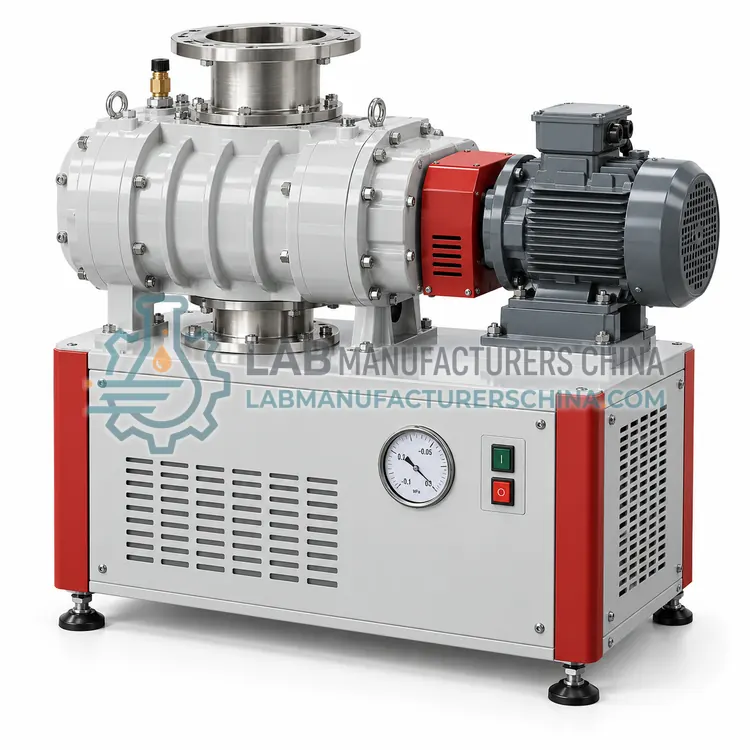
A roots vacuum booster pump uses two rotating lobes to increase the pumping speed of a backing pump in the medium-vacuum range. It is used to evacuate large chambers and to speed drying and coating cycles.
What is the Roots Vacuum Booster Pump?
A roots vacuum booster pump uses two rotating lobes to increase the pumping speed of a backing pump in the medium-vacuum range. It is used to evacuate large chambers and to speed drying and coating cycles.
Overview
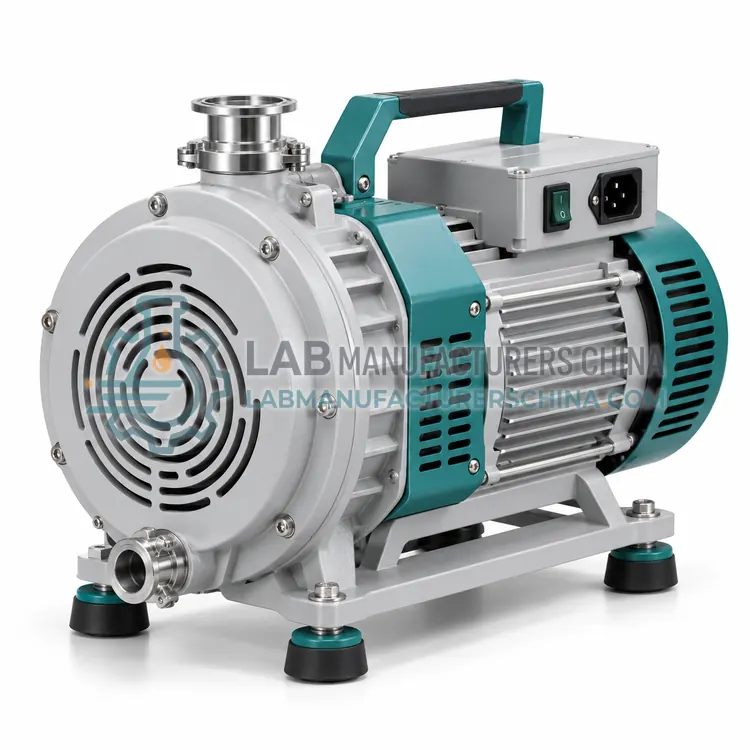
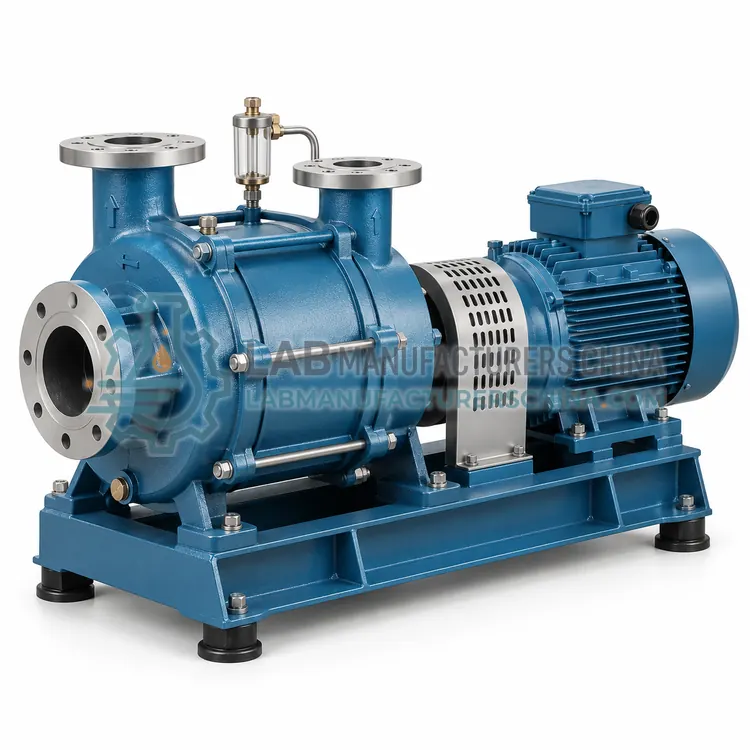
The roots pump has two figure-eight lobes that rotate in opposite directions inside a casing. The lobes trap gas and carry it from the inlet to the outlet without touching each other or the casing, so the pump runs dry and without internal lubrication. A roots pump cannot exhaust to atmosphere on its own because its compression ratio is modest, so it must be backed by a rotary vane, screw or water-ring pump. In that combination it can multiply pumping speed several times in the 10 to 0.01 mbar range, which shortens pump-down time for large chambers. Typical units move hundreds to thousands of cubic meters per hour. Cooling jackets control the heat generated by compression, and fine clearances mean the gas should be clean or pre-filtered. They are used in coating, drying, degassing, distillation and central vacuum systems.
How does it work?
Vacuum pumps remove gas molecules to lower pressure in a sealed volume. Positive-displacement types, including rotary vane, diaphragm, scroll and roots pumps, trap a volume of gas and push it out. Momentum-transfer pumps, including turbomolecular and diffusion pumps, accelerate molecules toward an exhaust that a backing pump removes. Water-ring and ejector pumps use a liquid or a jet to entrain and carry gas away. Performance is described by ultimate or base pressure and by pumping speed, which is measured in liters per second or cubic meters per hour. Real performance also depends on the gas load, on outgassing from chamber walls, and on the conductance of the connecting piping. Vapor handling, corrosion resistance and cleanliness determine which pump suits a given process, and pumps are often combined in stages to cover a wide pressure range.
What are the key features?
- Two counter-rotating lobes with no internal contact
- Multiplies backing pump speed by several times
- Effective in the 10–0.01 mbar range
- Flow of hundreds to thousands of m3/h
- Cooling jacket for compression heat
- Dry operation with no internal lubrication
What are the technical specifications?
A typical roots vacuum booster pump configuration offers pumping speed of 250–5,000 m3/h, effective pressure range of 10–0.01 mbar, max differential pressure of 50–100 mbar, number of lobes of 2, cooling of Water or air jacket and lubrication of Gearbox only, dry chamber. Values are indicative of the product class; the exact figures for each configuration are confirmed on the quotation and the calibration documents supplied with the instrument.
Which applications is it used for?
The Roots Vacuum Booster Pump is used in large chamber pump-down, vacuum coating and metallizing, drying and degassing, distillation systems and central vacuum boosting. Across the wider Vacuum Pumps class, laboratories also deploy it for chamber evacuation for drying and degassing, rotary evaporation and distillation and freeze drying and centrifugal concentration.
Which standards and certifications apply?
Relevant standards and methods include IEC 61010-1, IEC 61326-1, ISO 21360, ISO 27893, ISO 20485 and GB 4793.1. Certification candidates for this model are CE, ISO 9001 manufacturing and RoHS; each is to be confirmed for the specific configuration before shipment, and certificates are supplied only where they have been issued.
Protect the pump from the process with a cold trap, foreline trap or filter, and vent to atmosphere before switching off a high-vacuum pump. Change oil and check seals on schedule for oil-sealed pumps, and inspect scroll tips and diaphragms for dry pumps. Keep tubing as short and wide as possible to preserve conductance, and use the correct flange type and vacuum grease sparingly. Monitor pressure with gauges appropriate to the range, such as Pirani, capacitance or ion gauges. Follow IEC 61010-1 for electrical safety and local pressure equipment rules. For oil-free or clean processes, confirm that the pump cannot backstream oil or particles. Record base pressure and pump-down curves during commissioning and at each service so that degradation is detected early.
How do I select the right Roots Vacuum Booster Pump?
Add a roots booster when the chamber is large and pump-down time must be short, or when coating throughput matters. It always needs a backing pump. In the RFQ, state chamber volume, target pressure, pump-down time, backing pump and gas cleanliness.
How does it compare with other Vacuum Pumps variants?
Work from the required working pressure, the gas composition and the volume to be evacuated. For rough vacuum in filtration and drying, a diaphragm or single-stage rotary vane pump is sufficient. For medium vacuum in rotary evaporation and coating, a two-stage rotary vane or scroll pump is appropriate. For high and ultra-high vacuum in electron optics, surface analysis and semiconductor work, a turbomolecular pump with a suitable backing pump is needed. Consider whether the gas is condensable, corrosive or particle-laden, and add traps, filters and corrosion-resistant materials as required. Size pumping speed from the chamber volume, the target pressure and the acceptable pump-down time, remembering that conductance limits real speed. Decide between oil-sealed and dry designs based on contamination risk, and specify gauges, valves and controllers as part of the system.
Full specifications
| Pumping speed | 250–5,000 m3/h |
|---|---|
| Effective pressure range | 10–0.01 mbar |
| Max differential pressure | 50–100 mbar |
| Number of lobes | 2 |
| Cooling | Water or air jacket |
| Lubrication | Gearbox only, dry chamber |
| Inlet flange | DN 63–DN 200 |
| Motor power | 1.5–15 kW |
| Noise level | 65–80 dB(A) |
| Power supply | 380 V three-phase |
Indicative values for this product class. Final specifications are confirmed on the quotation and in the calibration documents supplied with the instrument.
Applications
- Large chamber pump-down
- Vacuum coating and metallizing
- Drying and degassing
- Distillation systems
- Central vacuum boosting
Key features
- Two counter-rotating lobes with no internal contact
- Multiplies backing pump speed by several times
- Effective in the 10–0.01 mbar range
- Flow of hundreds to thousands of m3/h
- Cooling jacket for compression heat
- Dry operation with no internal lubrication
Frequently asked questions about Roots Vacuum Booster Pump
Its compression ratio between inlet and outlet is limited, so it cannot discharge to atmosphere. A backing pump maintains a low foreline pressure and removes the gas the booster moves.
By three to ten times the backing pump speed in its effective range, depending on model and pressure. The gain is largest in the medium-vacuum region.
Compression heats the gas and the lobes, and clearances are very fine. A water or air jacket keeps temperatures within limits so the lobes do not seize or wear.
The pump type sets the base pressure, but outgassing, leaks, condensable vapor and the conductance of connections set the real value. Measure pressure at the chamber, not only at the pump inlet.
For high and ultra-high vacuum below about 10⁻³ mbar, such as electron microscopy, surface analysis and coating. It needs a backing pump to exhaust to atmosphere.
Use a cold trap or a condenser before the pump, and choose a gas ballast on oil-sealed pumps. Keep trap temperature low enough that the vapor pressure of the condensate is well below the working pressure.
Related models