Vezin Sample Divider
维津缩分器
- SKU SPL-0002
- Splitters
- CE (to be confirmed)
- ISO 9001 manufacturing (to be confirmed)
Price on request — FOB / CIF quoted per order
Prices depend on configuration, quantity and destination port.
Key specifications
| Applicable top size | Up to 30–40 mm depending on model |
|---|---|
| Collected fraction | Adjustable, commonly 1/8 to 1/30 |
| Rotation speed | 10–40 rpm |
| Feed rate | 50–1000 kg/h |
| Sample capacity | Up to 500 kg per pass |
| Mass deviation | ≤ 3 % |
Request a quote Download brochure · to be provided
By Lab Manufacturers China Technical TeamLast reviewed Standards: ISO 3082, ISO 12743, ASTM E877
What is the Vezin Sample Divider?
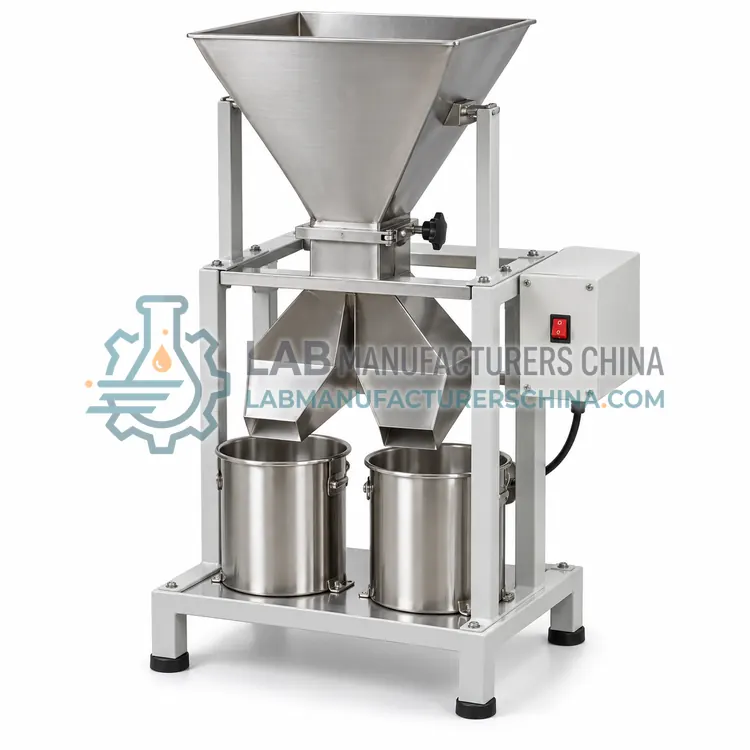
A Vezin sample divider takes repeated sector cuts from a falling ore stream with a rotating arm, so a fixed fraction is collected from many increments. It is well suited to coarse ore and large sample masses.
What is the Vezin Sample Divider?
A Vezin sample divider takes repeated sector cuts from a falling ore stream with a rotating arm, so a fixed fraction is collected from many increments. It is well suited to coarse ore and large sample masses.
Overview
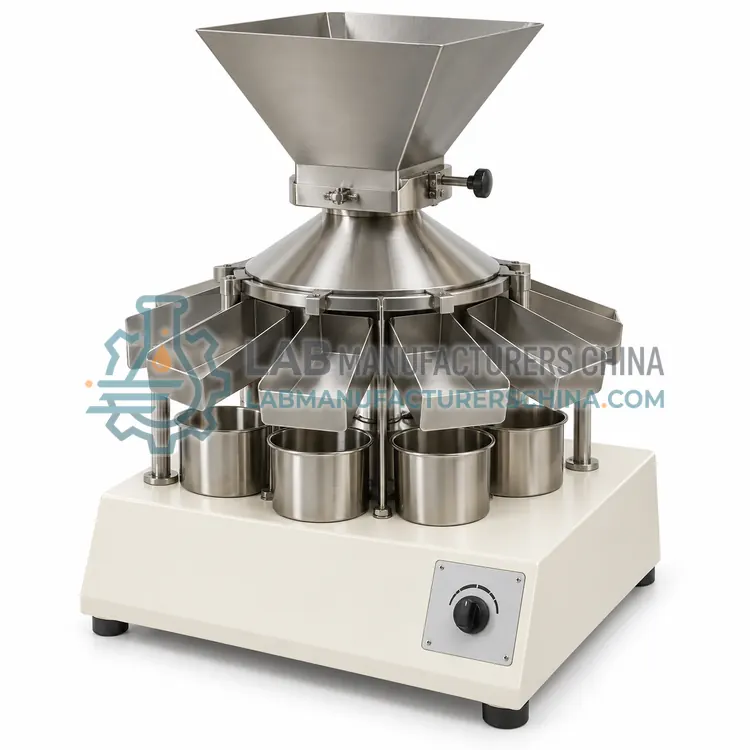
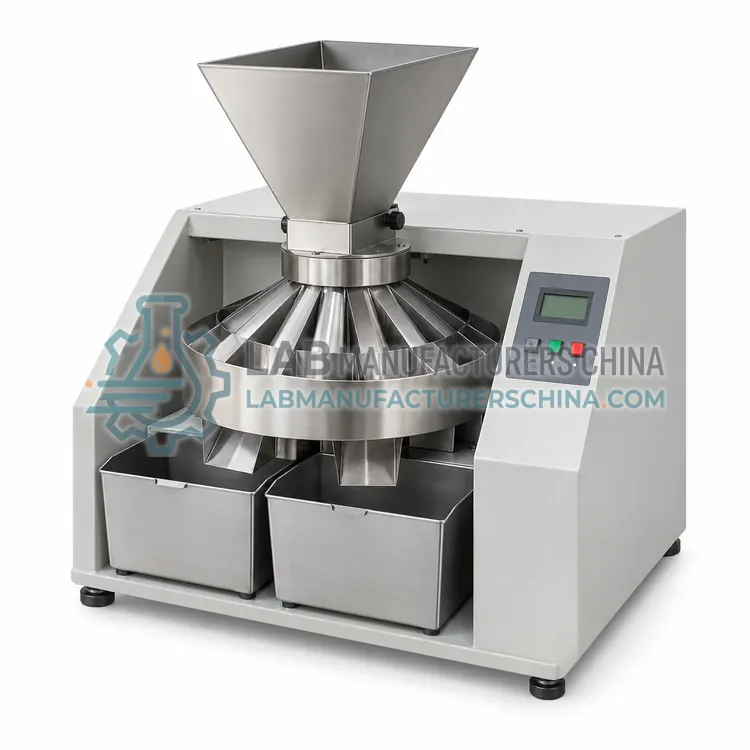
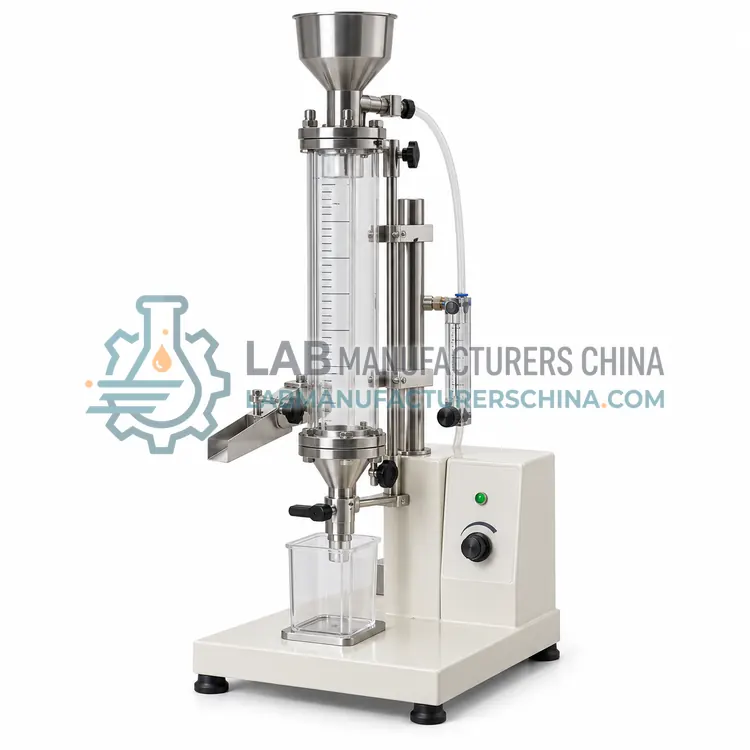
Material is fed at a controlled rate through a hopper and falls past a rotating radial arm that carries a sample chute and a reject chute. Each pass of the sampling chute collects one sector of the stream into a receiver, while the reject chute directs the remainder away. Over many rotations the collected fraction is a fixed proportion of the total, and because the cuts are taken at random positions in the falling stream, bias from segregation is reduced. Vezin dividers handle coarse material with top sizes up to tens of millimetres and can reduce large bulk samples in a single pass. Feed rate, hopper design and the cut opening must be matched to the material, and the whole device should be enclosed to control dust. The unit is often used in mine sample rooms and for referee subsampling.
How does it work?
Dividing must be proportional if the subsample is to represent the whole. Riffle splitters pour material across a bank of alternating chutes so that each side receives half. Vezin dividers take repeated sector cuts from a falling stream using a rotating arm, collecting a fixed fraction of many increments, which is effective for coarse ore. Rotary dividers rotate a set of vessels under a narrow falling stream so that each vessel receives an equal share of a full rotation. Rotary cone splitters distribute the whole stream around a rotating cone into surrounding containers of equal capacity, which suits large, coarse samples. Slurry splitters cut a falling pulp stream with a moving cutter or a rotating cone so that a small, well-mixed aliquot represents a large volume. Whichever type is used, the sample must be dry, free-flowing and mixed before dividing, and the device must be sized generously relative to the top particle size.
What are the key features?
- Rotating radial arm with sample and reject chutes
- Fixed collected fraction from many increments
- Controlled feed rate through a hopper
- Top size up to tens of millimetres
- Reduces bulk samples in a single pass
- Enclosed body with dust extraction connections
What are the technical specifications?
A typical vezin sample divider configuration offers applicable top size of Up to 30–40 mm depending on model, collected fraction of Adjustable, commonly 1/8 to 1/30, rotation speed of 10–40 rpm, feed rate of 50–1000 kg/h, sample capacity of Up to 500 kg per pass and mass deviation of ≤ 3 %. Values are indicative of the product class; the exact figures for each configuration are confirmed on the quotation and the calibration documents supplied with the instrument.
Which applications is it used for?
The Vezin Sample Divider is used in reduction of coarse bulk ore samples, mine and concentrator sample rooms, referee subsampling for disputes and aggregate and industrial mineral splitting. Across the wider Splitters class, laboratories also deploy it for subsample preparation for ore assay, bulk sample reduction at mine sites and aggregate and industrial mineral testing.
Which standards and certifications apply?
Relevant standards and methods include ISO 3082, ISO 12743, ASTM E877, ASTM C702, GB/T 2007 and IEC 61010-1. Certification candidates for this model are CE and ISO 9001 manufacturing; each is to be confirmed for the specific configuration before shipment, and certificates are supplied only where they have been issued.
Position dividers so the feed falls evenly and the whole stream is presented, since a stream that hugs one side of a riffle bank biases the split towards the other. Keep equipment clean and dry between samples, and clean chutes, vessels and cutters with brushes rather than water where moisture must be preserved. Weigh the fractions regularly and record the mass tolerance, because a persistent imbalance indicates wear, blockage or poor feeding technique. For riffle splitters, check that chute edges are not bent and that no chute is blocked. For Vezin and rotary units, verify the rotation speed and the cutter or vessel positions. For slurry splitters, agitate the pulp before and during splitting and check that the cutter passes fully through the stream. Calibrate and service motors, feeders and counters as part of the quality system.
How do I select the right Vezin Sample Divider?
Select the Vezin divider when coarse ore or large masses must be reduced accurately and a single pass is preferred. Specify top size, collected fraction, feed rate and rotation speed, and provide controlled feeding and dust extraction.
How does it compare with other Splitters variants?
Choose the splitter mainly from the top particle size and the mass to be divided. Riffle splitters are the general-purpose tool for material between about one and 25 mm, provided the chute width is at least two and a half to three times the top size. Vezin dividers handle coarse ore and large masses because each sector cut is small and the device takes many increments, which reduces bias from segregation. Rotary dividers give the best precision on fine material below about three millimetres and can be automated. Rotary cone splitters suit bulk samples where several equal portions must be produced quickly. For pulps, a slurry splitter with an agitator is essential because coarse particles settle within seconds. In every case, check the mass tolerance the method states, verify it by weighing the fractions, and keep the sample dry and consistent in size before dividing.
Full specifications
| Applicable top size | Up to 30–40 mm depending on model |
|---|---|
| Collected fraction | Adjustable, commonly 1/8 to 1/30 |
| Rotation speed | 10–40 rpm |
| Feed rate | 50–1000 kg/h |
| Sample capacity | Up to 500 kg per pass |
| Mass deviation | ≤ 3 % |
| Contact material | Stainless steel or mild steel |
| Power supply | 220/380 V, 50/60 Hz |
Indicative values for this product class. Final specifications are confirmed on the quotation and in the calibration documents supplied with the instrument.
Applications
- Reduction of coarse bulk ore samples
- Mine and concentrator sample rooms
- Referee subsampling for disputes
- Aggregate and industrial mineral splitting
Key features
- Rotating radial arm with sample and reject chutes
- Fixed collected fraction from many increments
- Controlled feed rate through a hopper
- Top size up to tens of millimetres
- Reduces bulk samples in a single pass
- Enclosed body with dust extraction connections
Frequently asked questions about Vezin Sample Divider
It takes many small cuts at different positions in the falling stream rather than one large cut, so segregation caused by size or density differences averages out instead of concentrating in the sample.
The ratio of the cut opening and arc to the full stream circumference, which the manufacturer sets and can often be adjusted with interchangeable chutes. Common fractions are one eighth to one thirtieth of the feed.
The collected fraction is only accurate if the stream flows at a steady rate and covers the cut opening uniformly. Pulsing or surging feed changes how much material each cut receives and biases the split.
Splitting only works if the material presented to the divider is uniform. Mixing disperses segregation that develops during crushing and handling, so that particles of different size and density have an equal chance of entering each fraction.
The top particle size. Chute width, cutter opening or vessel aperture must be at least two and a half to three times the largest particle, otherwise coarse particles bridge or are rejected and the split becomes biased.
Weigh the resulting fractions. They should agree within the tolerance given in the sampling standard or method, commonly a few percent. Persistent imbalance suggests uneven feeding, a blocked chute or worn equipment.