Laboratory Flotation Column
实验室浮选柱
- SKU FLE-0003
- Flotation Equipment
- CE (to be confirmed)
- ISO 9001 manufacturing (to be confirmed)
Price on request — FOB / CIF quoted per order
Prices depend on configuration, quantity and destination port.
Key specifications
| Column diameter | 50–150 mm |
|---|---|
| Column height | 1.0–4.0 m |
| Feed particle size | < 150 µm, best < 75 µm |
| Pulp density | 10–40 % solids by mass |
| Air flow rate | 0.5–5 L/min |
| Wash water flow | 0–2 L/min |
Request a quote Download brochure · to be provided
By Lab Manufacturers China Technical TeamLast reviewed Standards: ISO 8858-1, ASTM D5114, ISO 3082
What is the Laboratory Flotation Column?
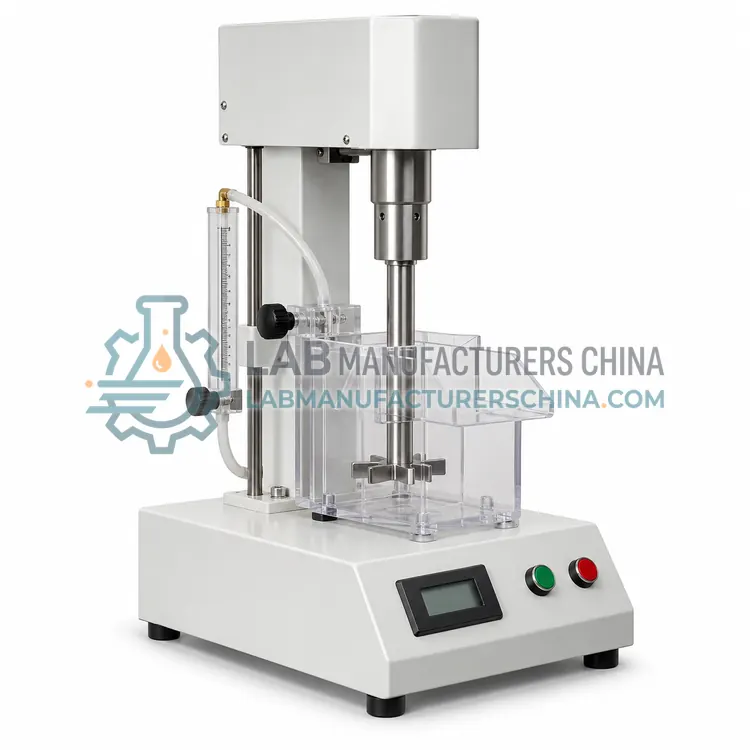
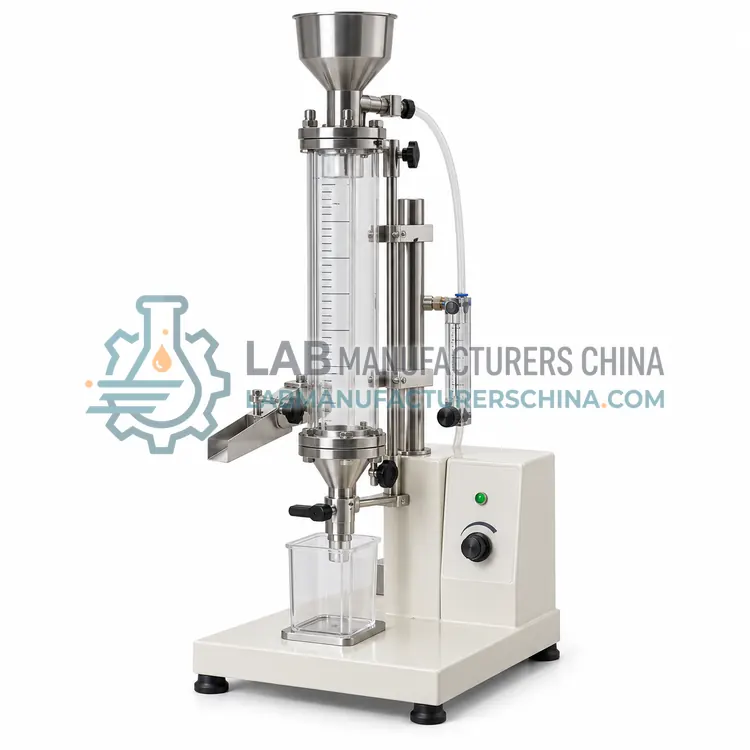
A laboratory flotation column is a tall, unagitated cell in which air is sparged at the base and pulp flows counter-current to rising bubbles, with wash water added near the top. It gives high grade in fine particle cleaning duties.
What is the Laboratory Flotation Column?
A laboratory flotation column is a tall, unagitated cell in which air is sparged at the base and pulp flows counter-current to rising bubbles, with wash water added near the top. It gives high grade in fine particle cleaning duties.
Overview
The column has no mechanical agitator. Pulp is introduced partway up the column and flows downward against a rising swarm of bubbles generated by a sparger at the base, while wash water is distributed near the top to rinse entrained gangue from the froth. Flotation therefore occurs in a deep froth zone and a collection zone, and performance depends on air rate, wash water rate, froth depth, feed rate and bubble size. Columns are effective for fine particles and for cleaning duties where entrained impurities limit concentrate grade, and they are used at bench scale to test column flotation before plant installation. Laboratory columns typically have diameters of 50 to 150 mm and heights of 1 to 4 m, and need feed and product pumps, a sparger, flow meters and instrumentation for level and interface control.
How does it work?
Froth flotation separates particles by their surface chemistry. The ore is ground to a size at which the target mineral is liberated, mixed with water to form a pulp of a chosen solids concentration, and conditioned with collectors that make selected minerals hydrophobic and frothers that stabilise bubbles. Air is dispersed into the pulp, either by a mechanical impeller that draws air from above or by forced air through a sparger, and hydrophobic particles attach to rising bubbles to form a froth that is scraped off as concentrate. Hydrophilic particles remain in the pulp and are discharged as tailings. Bench equipment therefore needs controllable agitation, aeration, pH and reagent addition, plus a cell that allows froth to be removed at a steady rate. Results are scaled up using retention time, solids concentration and reagent dosage per tonne, with grinding and liberation established separately by the ore's size distribution.
What are the key features?
- Tall column without mechanical agitation
- Sparger at the base producing fine bubbles
- Wash water distributor near the froth overflow
- Feed and product peristaltic pumps
- Level and froth depth instrumentation
- Transparent or sectional column for observation
What are the technical specifications?
A typical laboratory flotation column configuration offers column diameter of 50–150 mm, column height of 1.0–4.0 m, feed particle size of < 150 µm, best < 75 µm, pulp density of 10–40 % solids by mass, air flow rate of 0.5–5 L/min and wash water flow of 0–2 L/min. Values are indicative of the product class; the exact figures for each configuration are confirmed on the quotation and the calibration documents supplied with the instrument.
Which applications is it used for?
The Laboratory Flotation Column is used in fine particle cleaning and recleaning duties, column flotation circuit development, grade improvement studies at bench scale and comparison with mechanical cell performance. Across the wider Flotation Equipment class, laboratories also deploy it for reagent scheme development for ore bodies, rougher, cleaner and scavenger circuit configuration and grind size and liberation optimization.
Which standards and certifications apply?
Relevant standards and methods include ISO 8858-1, ASTM D5114, ISO 3082, ISO 12743, ASTM E877 and IEC 61010-1. Certification candidates for this model are CE and ISO 9001 manufacturing; each is to be confirmed for the specific configuration before shipment, and certificates are supplied only where they have been issued.
Calibrate and record the basic variables with every test: solids concentration, grind size distribution, pH, reagent dosages, air flow, impeller speed and flotation time. Rinse the cell and impeller thoroughly between tests, because residual collector changes the next result, and use consistent water quality, since dissolved ions affect flotation strongly in recycled plant water. Check impeller clearance and wear, air spargers, scraper blades and pH electrodes on a schedule. Provide splash guards, eye protection and fume extraction for reagent and acid handling, and store collectors and frothers safely. For result transfer to plant, run replicate tests and report grade and recovery with the metal balance closed; locked-cycle or cycle tests are then used to estimate steady-state performance before any plant trial.
How do I select the right Laboratory Flotation Column?
Select the laboratory column when entrainment limits grade in fine particle cleaning and the plant may later use column flotation. Specify diameter, height, feed and product pumping, sparging method, wash water distribution and the instrumentation provided for level control.
How does it compare with other Flotation Equipment variants?
Start from the ore mass available and the question to be answered. A single self-aerating or sub-aeration cell of one to three litres suits reagent screening, pH and dosage tests with a few hundred grams of sample. Multi-cell banks of three to eight cells are used for rougher, cleaner and scavenger configurations or for locked-cycle tests that approximate a continuous circuit. Flotation columns suit fine particles and cleaner duties where a deep froth and wash water give better grade. Conditioning tanks are needed whenever reagents require contact time before flotation, which is often the decisive step for collector performance. Check impeller and air-flow ranges against the pulp density you will use, whether froth scraping is manual or automatic, and whether the machine can hold pH, temperature and air rate stable enough for reproducible recoveries. Plan reagent dosing and water supply as part of the package.
Full specifications
| Column diameter | 50–150 mm |
|---|---|
| Column height | 1.0–4.0 m |
| Feed particle size | < 150 µm, best < 75 µm |
| Pulp density | 10–40 % solids by mass |
| Air flow rate | 0.5–5 L/min |
| Wash water flow | 0–2 L/min |
| Froth depth control | Adjustable by interface setpoint |
| Power supply | 220 V, 50/60 Hz |
Indicative values for this product class. Final specifications are confirmed on the quotation and in the calibration documents supplied with the instrument.
Applications
- Fine particle cleaning and recleaning duties
- Column flotation circuit development
- Grade improvement studies at bench scale
- Comparison with mechanical cell performance
Key features
- Tall column without mechanical agitation
- Sparger at the base producing fine bubbles
- Wash water distributor near the froth overflow
- Feed and product peristaltic pumps
- Level and froth depth instrumentation
- Transparent or sectional column for observation
Frequently asked questions about Laboratory Flotation Column
Wash water flows downward through the froth and displaces pulp entrained between bubbles, removing fine gangue that would otherwise report to the concentrate. It improves grade at some cost to recovery.
Columns are taller, so pulp residence time is often several minutes, which favours slow-floating fine particles. Mechanical cells rely on intense agitation to give particles many bubble contacts in a shorter time.
Flow meters for feed, air and wash water, level or interface measurement for froth depth control, pressure indication on the sparger, and sampling points on feed, concentrate and tailings for grade and mass balance.
It measures how much of the target mineral reports to the froth concentrate and how much remains in the tailings, under stated conditions of grind size, pulp density, pH, reagent dosage and flotation time. Replicate tests quantify repeatability.
One to three litres suits most reagent and dosage tests with a few hundred grams of ore. Larger cells are used when more concentrate is needed for further testing, and smaller cells when sample material is scarce, such as drill core composites.
Collectors need time to adsorb on mineral surfaces before air is introduced. Too short a conditioning time lowers recovery, while excessive time can allow reagents to desorb or oxidize, so the optimum is established by test.
Related models