Hammer Mill
锤式粉碎机
- SKU MIL-0004
- Mills
- CE (to be confirmed)
- ISO 9001 manufacturing (to be confirmed)
Price on request — FOB / CIF quoted per order
Prices depend on configuration, quantity and destination port.
Key specifications
| Final particle size | 0.1–3 mm, screen dependent |
|---|---|
| Max feed size | 10 mm |
| Throughput | Up to 10 kg/h |
| Rotor speed | 2,000–6,000 rpm |
| Hammer material | Hardened steel |
| Screen options | 0.5, 1, 2 mm |
Request a quote Download brochure · to be provided
By Lab Manufacturers China Technical TeamLast reviewed Standards: ISO 3310-1, ASTM E11, ISO 2591-1
What is the Hammer Mill?
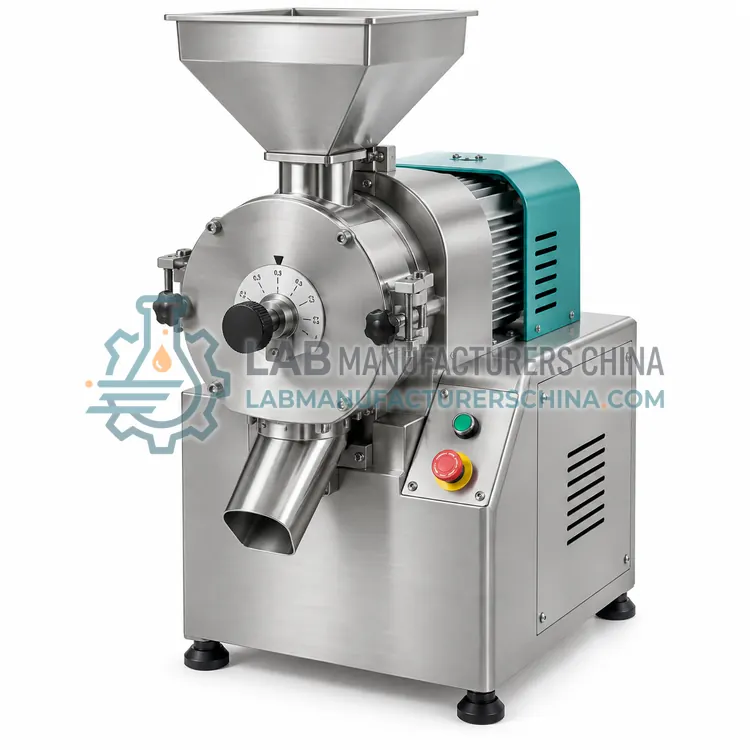
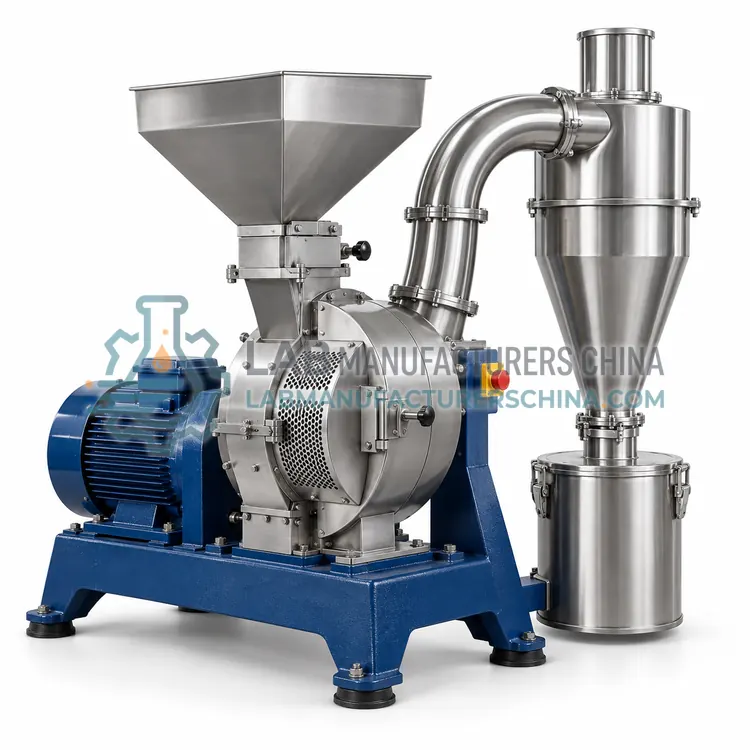
A hammer mill grinds material with swinging hammers that strike it against a screen. It handles medium-hard and brittle samples at high throughput and is used for grains, minerals and chemicals in sample preparation.
What is the Hammer Mill?
A hammer mill grinds material with swinging hammers that strike it against a screen. It handles medium-hard and brittle samples at high throughput and is used for grains, minerals and chemicals in sample preparation.
Overview
A hammer mill uses a rotor carrying swinging hammers inside a chamber fitted with a screen or grate. The hammers strike the feed and drive it against the screen, and particles small enough pass through while larger ones are struck again. This gives high throughput and a reasonably uniform product set mainly by the screen aperture. Swinging hammers retract when uncrushable objects enter, which protects the rotor. The design suits brittle and medium-hard materials such as grains, dried plants, minerals and chemicals, and is common in food, feed and agricultural laboratories. Abrasive feed wears the hammers and screen.
How does it work?
Mills reduce particle size by moving grinding media or tools against the sample. A ball mill rotates a jar containing balls, so the sample is ground by cascading impact and friction. A planetary ball mill rotates jars on a sun wheel in the opposite direction, generating high centrifugal energy and fast, fine grinding. A disc mill presses material between discs, a hammer mill strikes it with swinging hammers against a screen, and a jet mill accelerates particles in a gas stream so they break by inter-particle collision without contact with grinding media. The achievable fineness depends on the energy applied, the grinding time and the material, and contamination depends on the tool and jar materials.
What are the key features?
- Swinging hammers striking against a screen
- High throughput with uniform product
- Interchangeable screens for particle size
- Retracting hammers protect the rotor
- Suitable for grains, minerals and chemicals
What are the technical specifications?
A typical hammer mill configuration offers final particle size of 0.1–3 mm, screen dependent, max feed size of 10 mm, throughput of Up to 10 kg/h, rotor speed of 2,000–6,000 rpm, hammer material of Hardened steel and screen options of 0.5, 1, 2 mm. Values are indicative of the product class; the exact figures for each configuration are confirmed on the quotation and the calibration documents supplied with the instrument.
Which applications is it used for?
The Hammer Mill is used in grain and feed milling, dried plant and biomass grinding, mineral and chemical sample reduction and food quality and analysis preparation. Across the wider Mills class, laboratories also deploy it for X-ray fluorescence and diffraction sample preparation, mineral, ore and cement fine grinding and pharmaceutical and chemical powder milling.
Which standards and certifications apply?
Relevant standards and methods include ISO 3310-1, ASTM E11, ISO 2591-1, EPA 3050B and IEC 61010-1. Certification candidates for this model are CE and ISO 9001 manufacturing; each is to be confirmed for the specific configuration before shipment, and certificates are supplied only where they have been issued.
Match the jar and ball materials to the sample and the analytes of interest: agate for clean grinding, zirconia and tungsten carbide for harder samples, and stainless steel for general work. Do not exceed the recommended fill, since too much sample or too few balls reduces efficiency, while too many balls leave no space for movement. Grind in intervals to limit heating, which can change the sample or lose volatiles. Clean jars between samples and check wear, since worn media contaminate and no longer transfer energy efficiently. Verify particle size by sieving or laser diffraction, and follow the safety and guarding requirements for the equipment.
How do I select the right Hammer Mill?
Choose a hammer mill for brittle and medium-hard samples needing high throughput and a uniform product. Confirm the screen range gives the required particle size, the hammer material suits the abrasiveness and the throughput matches the workload. For soft or elastic samples, a cutting mill is more suitable.
How does it compare with other Mills variants?
Choose a mill according to the required final particle size and the sample hardness. A planetary ball mill reaches very fine sizes quickly and suits hard and brittle material; a standard ball mill suits larger batches and gentler grinding; a disc mill gives reproducible size for X-ray analysis; a hammer mill handles medium-hard brittle samples at higher throughput; and a jet mill gives very fine, contamination-free powder without grinding media. Confirm the final size range, batch capacity and jar or tool materials, and choose a material that does not introduce the elements being analyzed. Consider whether wet or dry grinding, and inert or cryogenic conditions, are needed.
Full specifications
| Final particle size | 0.1–3 mm, screen dependent |
|---|---|
| Max feed size | 10 mm |
| Throughput | Up to 10 kg/h |
| Rotor speed | 2,000–6,000 rpm |
| Hammer material | Hardened steel |
| Screen options | 0.5, 1, 2 mm |
| Motor power | 0.75–2.2 kW |
| Collection vessel | 1–5 L |
| Noise level | About 78 dB(A) |
| Power supply | 380 V AC, three phase |
Indicative values for this product class. Final specifications are confirmed on the quotation and in the calibration documents supplied with the instrument.
Applications
- Grain and feed milling
- Dried plant and biomass grinding
- Mineral and chemical sample reduction
- Food quality and analysis preparation
Key features
- Swinging hammers striking against a screen
- High throughput with uniform product
- Interchangeable screens for particle size
- Retracting hammers protect the rotor
- Suitable for grains, minerals and chemicals
Frequently asked questions about Hammer Mill
The screen or grate aperture sets the maximum particle size, since material is retained until small enough to pass. Screen changes are the usual adjustment, while rotor speed and feed rate fine-tune the result. A finer screen reduces throughput and increases heat.
Swinging hammers fold back if a hard or uncrushable object enters the chamber, reducing the risk of damage to the rotor and drive. They also self-position against the material, which helps maintain grinding efficiency as the hammers wear unevenly.
Hammers and screens are the wear parts and are replaced when product size drifts or throughput falls. The rotor bearings require lubrication, and the chamber is cleaned between samples. An unbalanced or worn rotor should be corrected to avoid vibration and premature bearing failure.
A ball mill rotates a jar so balls cascade and tumble, giving gentle grinding over a longer time. A planetary ball mill rotates jars in the opposite direction to the supporting disc, producing much higher centrifugal energy, faster grinding and a finer final size for the same sample.
Choose jar and ball materials that do not contain the elements being measured and that are hard enough not to wear excessively. Agate suits most trace work, zirconia and tungsten carbide suit harder samples, and plastic jars can be used where metal contamination must be avoided entirely.
The ball-to-powder ratio is the mass of grinding balls to the mass of sample. Higher ratios transfer more energy and grind faster but generate more heat, while lower ratios are gentler. Typical ratios range from about five to one up to twenty to one, set by the material and target size.
Related models