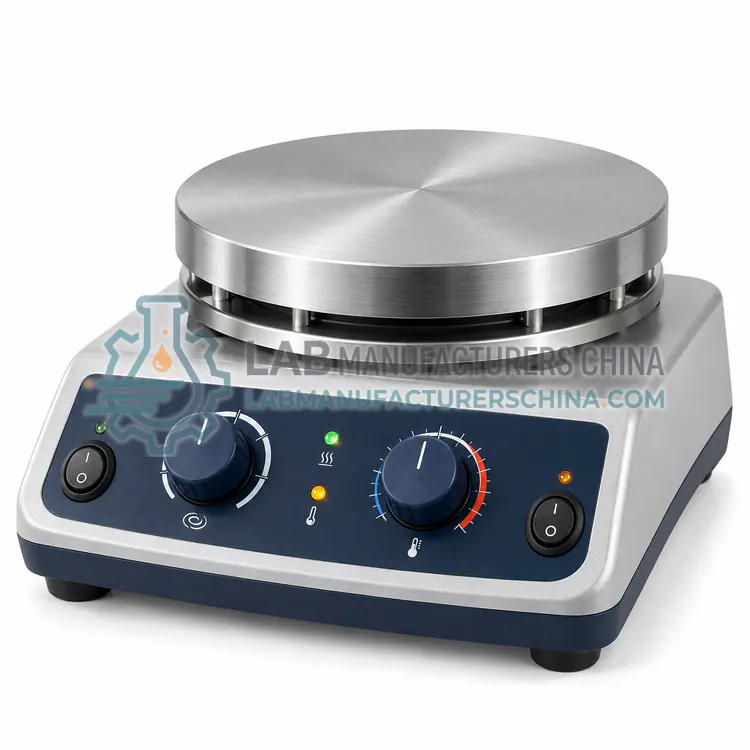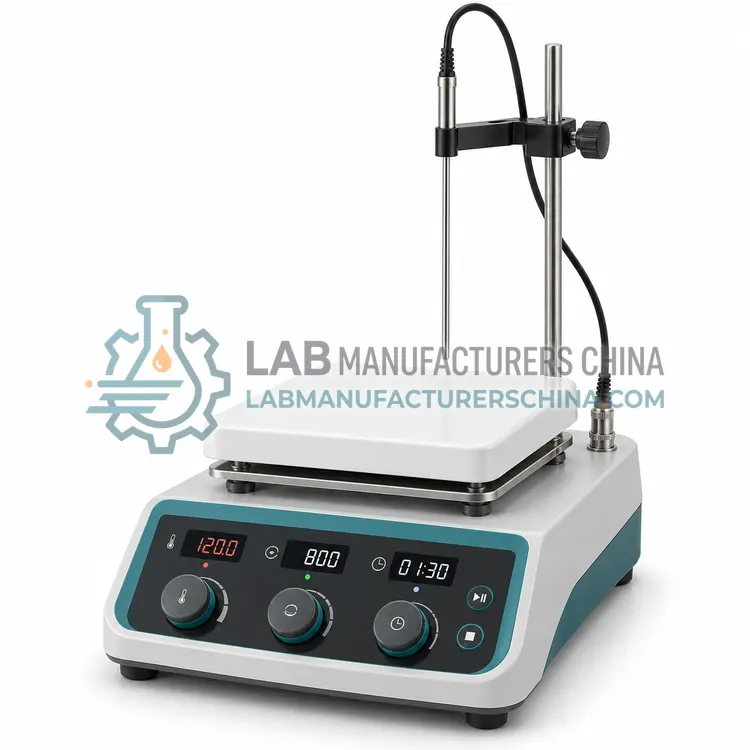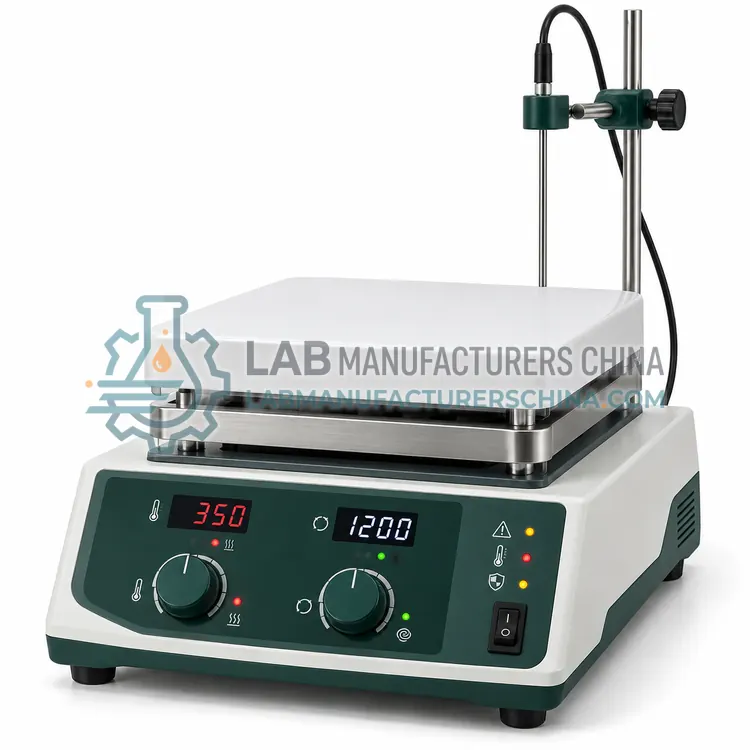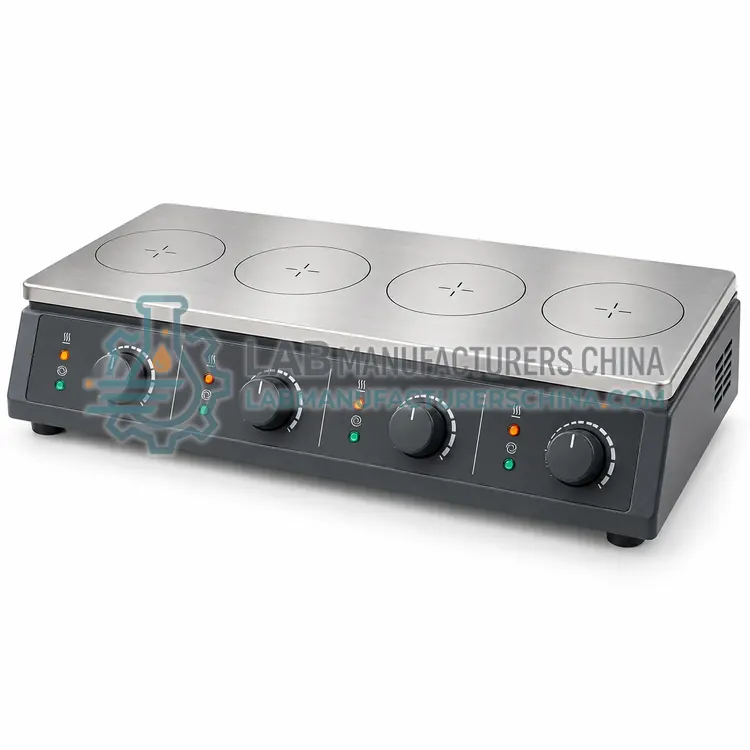
Hotplate Stirrer with Heating Block for Reaction Vials
带反应小瓶加热块的加热磁力搅拌器
- SKU HOS-0005
- Hotplate Stirrers
- CE (to be confirmed)
- RoHS (to be confirmed)
- ISO 9001 manufacturing (to be confirmed)
Price on request — FOB / CIF quoted per order
Prices depend on configuration, quantity and destination port.
Key specifications
| Temperature range | Ambient to 300 °C |
|---|---|
| Temperature control accuracy | ±1 °C |
| Block temperature uniformity | ±1.5 °C across wells |
| Number of positions | 4–24 vials |
| Vial/flask size | 2–100 mL |
| Stirring speed | 100–1,500 rpm |
Request a quote Download brochure · to be provided
By Lab Manufacturers China Technical TeamLast reviewed Standards: IEC 61010-1, IEC 61010-2-010, IEC 61326-1
What is the Hotplate Stirrer with Heating Block for Reaction Vials?
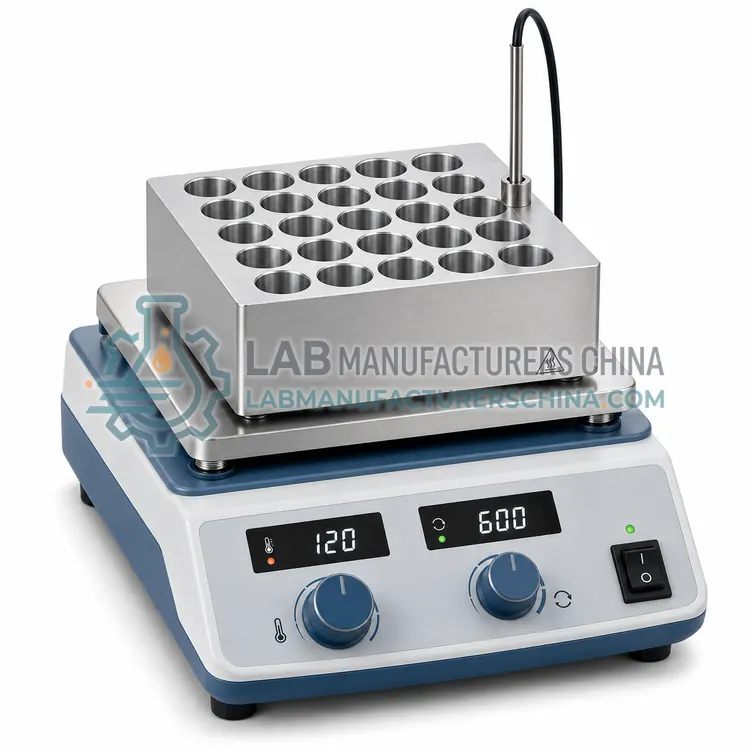
This hotplate stirrer is used with machined aluminum heating blocks that hold multiple vials or flasks, giving uniform conductive heating and stirring to several small reactions at once. It suits parallel synthesis, reaction screening and small-scale sample preparation.
What is the Hotplate Stirrer with Heating Block for Reaction Vials?
This hotplate stirrer is used with machined aluminum heating blocks that hold multiple vials or flasks, giving uniform conductive heating and stirring to several small reactions at once. It suits parallel synthesis, reaction screening and small-scale sample preparation.
Overview
Instead of heating a beaker on an open plate, this format places vials or small flasks into wells drilled in an aluminum block that sits on the hotplate. The block surrounds each vessel, giving more uniform heating and less dependence on flask shape. Typical blocks hold 4 to 24 vials of 2 to 40 mL, or round-bottom flasks of 10 to 100 mL. A thermocouple or PT1000 probe inserted in a reference well controls block temperature with PID, often to ±1 °C, and stirring continues through the block by magnets beneath. Maximum temperature is typically 200 to 300 °C, constrained by vial and seal materials. Blocks can be fitted with lids or condenser plates for reflux, and temperature uniformity across wells is a key specification in screening experiments.
How does it work?
A hotplate stirrer has an electrical heating element, typically a resistive coil or film, bonded to a plate of aluminum, ceramic or glass-ceramic, with a magnet drive below it for stirring. A temperature sensor in the plate, or an external PT1000 probe placed in the liquid, feeds a controller that regulates power by PID or on-off control. External probe control is more accurate because the liquid temperature, not the plate, is held at the set point, which avoids overshoot and overheating. A separate safety circuit, typically a bimetal switch or independent electronic limit, cuts power if plate temperature exceeds a fixed value. Plate material affects heat distribution and chemical resistance: aluminum heats evenly and quickly, ceramic resists corrosion, and glass-ceramic is easy to clean. Residual-heat indicators warn users that the plate remains hot after switching off.
What are the key features?
- Aluminum block holds 4–24 vials or flasks for parallel reactions
- Conductive heating around vessels improves uniformity
- PID control with probe in reference well
- Magnetic stirring continues through the block
- Interchangeable blocks for different vial and flask sizes
- Optional lids and condenser plates for reflux and inert gas
What are the technical specifications?
A typical hotplate stirrer with heating block for reaction vials configuration offers temperature range of Ambient to 300 °C, temperature control accuracy of ±1 °C, block temperature uniformity of ±1.5 °C across wells, number of positions of 4–24 vials, vial/flask size of 2–100 mL and stirring speed of 100–1,500 rpm. Values are indicative of the product class; the exact figures for each configuration are confirmed on the quotation and the calibration documents supplied with the instrument.
Which applications is it used for?
The Hotplate Stirrer with Heating Block for Reaction Vials is used in parallel organic synthesis, reaction condition screening, small-scale sample derivatization, heated extraction in vials and crystallization studies. Across the wider Hotplate Stirrers class, laboratories also deploy it for heated dissolution of solids, synthesis under controlled temperature and solvent evaporation in beakers.
Which standards and certifications apply?
Relevant standards and methods include IEC 61010-1, IEC 61010-2-010, IEC 61326-1, GB 4793.1, GB 4793.9 and ISO 9001. Certification candidates for this model are CE, RoHS and ISO 9001 manufacturing; each is to be confirmed for the specific configuration before shipment, and certificates are supplied only where they have been issued.
Use the unit on a heat-resistant, level surface and keep flammable materials away from the plate. Never heat a sealed vessel. Avoid spills on hot plates, since thermal shock can crack glass-ceramic and corrosive spills damage coatings. Place the external probe in the liquid, not touching the vessel wall, and use a probe clamp or holder. Do not exceed the rated temperature and confirm that the independent safety cut-out works during periodic inspection. Allow plates to cool fully before cleaning. Verify temperature with a calibrated thermometer periodically and record the result. For electrical safety refer to IEC 61010-1 and IEC 61010-2-010, and for hazardous solvents consider the fume-hood airflow and ignition sources.
How do I select the right Hotplate Stirrer with Heating Block for Reaction Vials?
Select a block system when several small reactions must run under identical heating and stirring. For a single beaker or flask, a plain hotplate stirrer is simpler. Specify vial sizes, number of positions, temperature range, uniformity needs and accessories such as condensers and lids in your RFQ.
How does it compare with other Hotplate Stirrers variants?
Choose the plate material and maximum temperature first: aluminum for even heating up to about 380 °C, ceramic or glass-ceramic for corrosion resistance and up to 500 to 550 °C, and stainless steel where mechanical strength is needed. Decide whether plate-only control is sufficient or an external PT1000 probe with PID is needed for accurate liquid temperature. Check the independent safety circuit and its cut-out value, which matters when working with flammable solvents. Match plate diameter to vessel size, typically 135 to 200 mm for beakers and flasks, and confirm maximum stirring volume and speed range. Consider digital display, interface, hood compatibility and whether the housing is spark-free or has sealed controls. For temperature-sensitive samples choose a model with low overshoot and tested accuracy. Specify voltage and plug type.
Full specifications
| Temperature range | Ambient to 300 °C |
|---|---|
| Temperature control accuracy | ±1 °C |
| Block temperature uniformity | ±1.5 °C across wells |
| Number of positions | 4–24 vials |
| Vial/flask size | 2–100 mL |
| Stirring speed | 100–1,500 rpm |
| Block material | Anodized aluminum |
| Temperature sensor | PT1000 in reference well |
| Heating power | 600–1,000 W |
| Safety limit | Independent, adjustable |
Indicative values for this product class. Final specifications are confirmed on the quotation and in the calibration documents supplied with the instrument.
Applications
- Parallel organic synthesis
- Reaction condition screening
- Small-scale sample derivatization
- Heated extraction in vials
- Crystallization studies
Key features
- Aluminum block holds 4–24 vials or flasks for parallel reactions
- Conductive heating around vessels improves uniformity
- PID control with probe in reference well
- Magnetic stirring continues through the block
- Interchangeable blocks for different vial and flask sizes
- Optional lids and condenser plates for reflux and inert gas
Frequently asked questions about Hotplate Stirrer with Heating Block for Reaction Vials
Typical blocks hold 4 to 24 vials of 2 to 40 mL, depending on vial diameter and plate size. Larger flasks reduce capacity to a few positions. Blocks are interchangeable, so one hotplate can serve several vessel formats.
Good blocks keep wells within about ±1 to ±2 °C of each other at steady state, depending on load and temperature. Uniformity is worse at high temperature and with partial loading, so request the test conditions and data.
Yes, with condenser plates or reflux caps that cool vapors above the block. Specify the required solvent boiling points and cooling liquid connection so the accessory and heating power are matched.
A hotplate stirrer heats and stirs a liquid at the same time. It is used to dissolve solids faster, run temperature-dependent reactions, prepare agar and media, evaporate solvent and keep samples uniform while heated in beakers and flasks.
A probe in the liquid measures the actual sample temperature, so the controller avoids the overshoot that occurs when it regulates plate temperature alone. It gives more accurate, repeatable control and adds protection through a separate limit on plate temperature.
Aluminum heats quickly and evenly and is economical but can be attacked by acids and alkalis unless coated. Ceramic and glass-ceramic resist chemicals and reach higher temperatures, but heat more slowly and can crack under thermal shock.