Flame Photometer for Fertilizer Potassium
肥料钾火焰光度计
- SKU FEA-0003
- Fertilizer Analysis
- CE (to be confirmed)
- RoHS (to be confirmed)
- ISO 9001 manufacturing (to be confirmed)
Price on request — FOB / CIF quoted per order
Prices depend on configuration, quantity and destination port.
Key specifications
| Measurement principle | Flame emission photometry |
|---|---|
| Element | Potassium (766 nm), sodium optional |
| Potassium range | 0–100 mg/L (diluted) |
| Detection limit | 0.05 mg/L |
| Accuracy | ±2% of reading |
| Repeatability | RSD ≤ 1% |
Request a quote Download brochure · to be provided
By Lab Manufacturers China Technical TeamLast reviewed Standards: ISO 5315 (total nitrogen), ISO 5317 (potassium), ISO 6598 (phosphorus)
What is the Flame Photometer for Fertilizer Potassium?
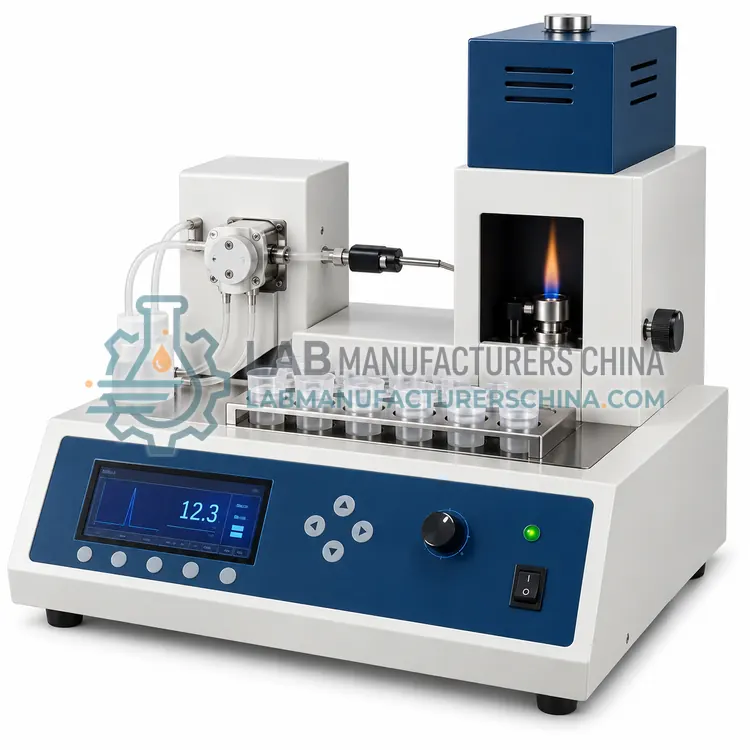
An instrument that measures potassium in fertilizer extracts by flame emission in a few seconds. It is the right choice for routine determination of K2O in fertilizer laboratories and production quality control.
What is the Flame Photometer for Fertilizer Potassium?
An instrument that measures potassium in fertilizer extracts by flame emission in a few seconds. It is the right choice for routine determination of K2O in fertilizer laboratories and production quality control.
Overview
The flame photometer aspirates a diluted fertilizer extract into a flame, where potassium atoms are excited and emit light at 766 nm. A photodetector measures the emission intensity, which is proportional to concentration over a useful range, and the result is converted to K2O content. Sodium and calcium can emit strongly and interfere, so the instrument is calibrated with matrix-matched standards or the sample is diluted and analysed with a suitable filter. Lithium is sometimes added as an internal standard to compensate for aspiration and flame variation. Compressed air and fuel gas supply the flame, and a nebuliser and mixing chamber must be kept clean to avoid drift. Measurements take seconds and cost little per sample, making flame photometry the standard routine method for potassium, while atomic absorption or inductively coupled plasma is used when lower detection limits or multi-element analysis is needed.
How does it work?
Fertilizer analysis uses classical chemistry and instrumental methods. Total nitrogen is determined by Kjeldahl digestion with sulfuric acid and a catalyst, distillation of ammonia into boric acid and titration, or by combustion in an elemental analyzer that measures the released nitrogen. Phosphorus is extracted and measured gravimetrically as quinoline phosphomolybdate, spectrophotometrically as the molybdenum blue complex or by inductively coupled plasma emission. Potassium is determined by flame emission or atomic absorption after extraction, since potassium atoms emit at characteristic wavelengths when excited in a flame. Near-infrared instruments predict nitrogen, phosphorus, potassium, moisture and organic matter from reflectance spectra using calibrations. Granule strength is measured by compressing single granules between platens and recording the breaking force, while moisture is found by loss on drying or by capacitance.
What are the key features?
- Flame emission gives potassium results in a few seconds.
- Narrow-band filter isolates the 766 nm potassium line.
- Internal lithium standard compensates for aspiration drift.
- Low reagent cost suits high routine sample throughput.
- Direct readout in concentration or K2O percentage.
- Simple maintenance with clean nebuliser and burner.
What are the technical specifications?
A typical flame photometer for fertilizer potassium configuration offers measurement principle of Flame emission photometry, element of Potassium (766 nm), sodium optional, potassium range of 0–100 mg/L (diluted), detection limit of 0.05 mg/L, accuracy of ±2% of reading and repeatability of RSD ≤ 1%. Values are indicative of the product class; the exact figures for each configuration are confirmed on the quotation and the calibration documents supplied with the instrument.
Which applications is it used for?
The Flame Photometer for Fertilizer Potassium is used in fertilizer K2O determination, potassium salt production control, soil extract potassium measurement and incoming raw material inspection. Across the wider Fertilizer Analysis class, laboratories also deploy it for fertilizer production quality control, blending plant formulation checks and import and export inspection.
Which standards and certifications apply?
Relevant standards and methods include ISO 5315 (total nitrogen), ISO 5317 (potassium), ISO 6598 (phosphorus), EN 13266, AOAC 955.04 and GB/T 8572 (total nitrogen). Certification candidates for this model are CE, RoHS and ISO 9001 manufacturing; each is to be confirmed for the specific configuration before shipment, and certificates are supplied only where they have been issued.
Grind and homogenise samples properly, because nutrient distribution in blended fertilizers is uneven and a small scoop can mislead. Follow the extraction and digestion conditions exactly for reference methods, including acid strength, temperature and time, and run reagent blanks and certified reference materials with each batch. For flame emission, control flame conditions and calibrate with matrix-matched standards to limit interference from sodium, calcium and other elements. Keep near-infrared calibrations current by adding local products and verifying with reference analyses. Handle concentrated acids and reagents with appropriate ventilation and personal protection, and neutralise or dispose of waste according to local rules. Maintain balances and ovens on a calibration schedule and record all method parameters for traceability.
How do I select the right Flame Photometer for Fertilizer Potassium?
Select the flame photometer for routine potassium determination where speed and low cost per sample matter. When multi-element analysis or very low detection limits are needed, use atomic absorption or ICP emission spectrometry. In an RFQ, specify the concentration range, dilution protocol, internal standard and gas supply.
How does it compare with other Fertilizer Analysis variants?
Choose methods according to the parameter, the required accuracy and the throughput. For official label verification and disputes, use reference chemistry: Kjeldahl or combustion for nitrogen, gravimetric or spectrophotometric methods for phosphorus and flame emission for potassium. For routine production control at high throughput, near-infrared analyzers give rapid multi-nutrient estimates once calibrated to the product lines and checked against reference chemistry. For physical quality, select a granule strength tester and a moisture analyzer suited to the product form, since granules, prills and powders behave differently. Consider sample preparation, including grinding and extraction, the reagent and waste handling for wet chemistry, and whether results must be reported on a dry basis. Confirm the standard methods required by the applicable national regulation or contract.
Full specifications
| Measurement principle | Flame emission photometry |
|---|---|
| Element | Potassium (766 nm), sodium optional |
| Potassium range | 0–100 mg/L (diluted) |
| Detection limit | 0.05 mg/L |
| Accuracy | ±2% of reading |
| Repeatability | RSD ≤ 1% |
| Flame | Air–propane or air–LPG |
| Internal standard | Lithium, optional |
| Sample uptake | 2–5 mL/min |
| Outputs | USB, RS-232, analog |
| Power supply | 220 VAC, 50 Hz |
Indicative values for this product class. Final specifications are confirmed on the quotation and in the calibration documents supplied with the instrument.
Applications
- Fertilizer K2O determination
- Potassium salt production control
- Soil extract potassium measurement
- Incoming raw material inspection
Key features
- Flame emission gives potassium results in a few seconds.
- Narrow-band filter isolates the 766 nm potassium line.
- Internal lithium standard compensates for aspiration drift.
- Low reagent cost suits high routine sample throughput.
- Direct readout in concentration or K2O percentage.
- Simple maintenance with clean nebuliser and burner.
Frequently asked questions about Flame Photometer for Fertilizer Potassium
Fertilizer extracts can contain hundreds to thousands of milligrams per litre of potassium, far above the linear range of flame photometry. Diluting to between 1 and 20 mg/L keeps the emission in the calibrated range and reduces matrix interference from other salts.
Sodium, calcium, lithium and other easily excited elements can contribute to the signal or suppress it through chemical and ionization effects. Matrix-matched standards, a narrow filter and adequate dilution control these effects, and lithium is often added as an internal standard.
A series of potassium standards covering the working range is aspirated, and the emission response is fitted to a curve. Standards are prepared in the same acid or salt matrix as the samples so that viscosity and other salts affect both equally.
Nitrogen is determined by Kjeldahl digestion or combustion, phosphorus by extraction and gravimetric or spectrophotometric measurement, and potassium by flame emission or atomic absorption. Results are reported as N, P2O5 and K2O percentages and compared with the label declaration.
Blended fertilizers contain particles with very different nutrient contents, so an unground scoop may not represent the lot. Grinding and mixing to a uniform powder before subsampling ensures the small analytical portion represents the whole batch.
It measures the force needed to break a single granule and reflects resistance to handling, storage and spreading. Weak granules produce dust and segregate in blends, while excessive strength may slow dissolution in soil.
Related models