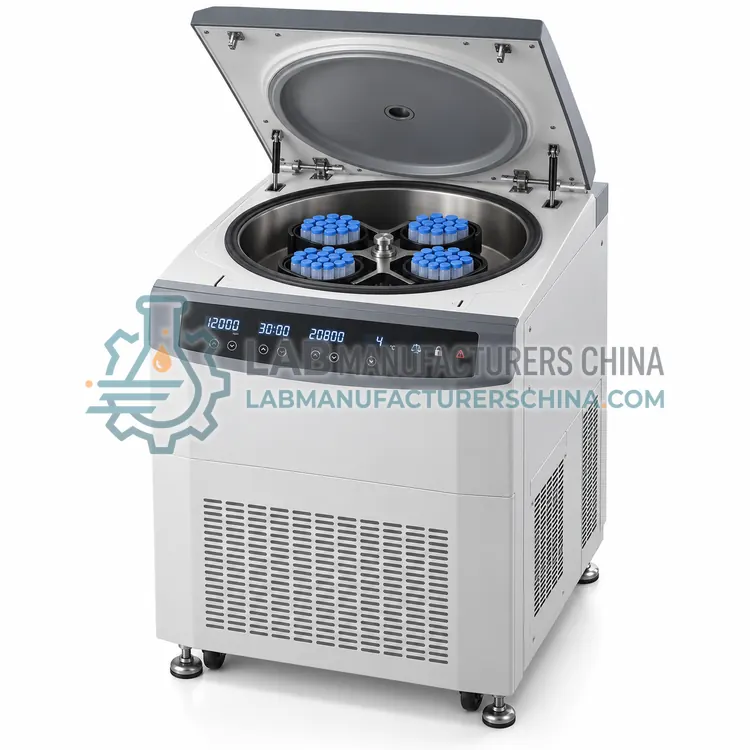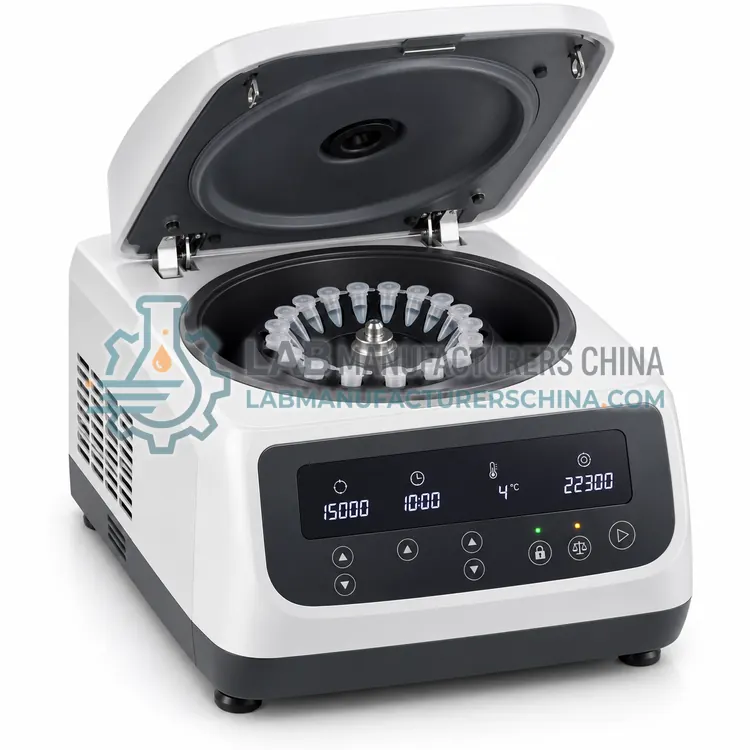
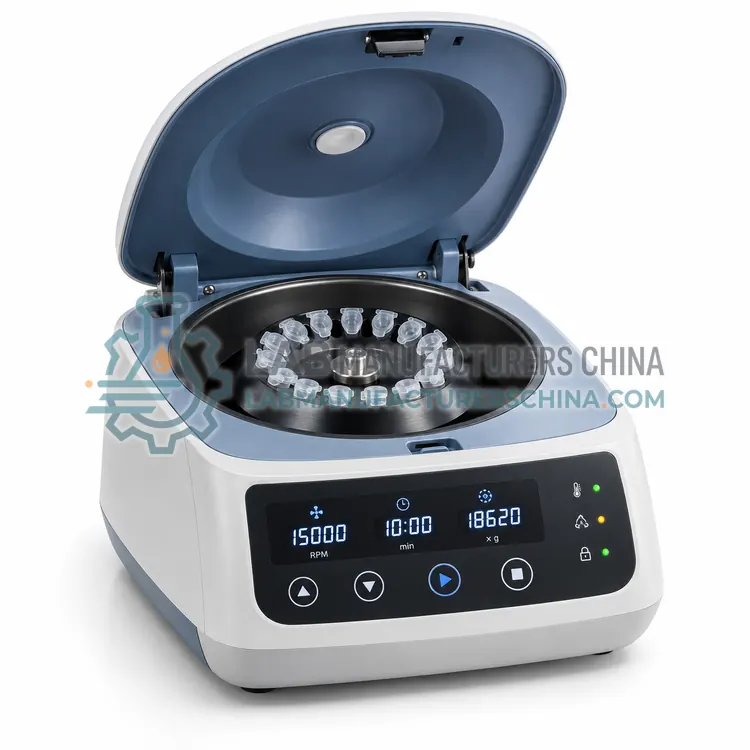
High-Speed Microcentrifuge
高速微量离心机
- SKU MIC-0001
- Microcentrifuges
- CE (to be confirmed)
- ISO 9001 manufacturing (to be confirmed)
- RoHS (to be confirmed)
Price on request — FOB / CIF quoted per order
Prices depend on configuration, quantity and destination port.
Key specifications
| Maximum speed | 15,000–18,000 rpm |
|---|---|
| Maximum RCF | 18,000–21,000 x g |
| Rotor capacity | 24 x 1.5/2.0 mL |
| Acceleration time | ≤ 20 s |
| Braking time | ≤ 20 s |
| Timer range | 10 s–99 min |
Request a quote Download brochure · to be provided
By Lab Manufacturers China Technical TeamLast reviewed Standards: IEC 61010-1, IEC 61010-2-020, IEC 61326-1
What is the High-Speed Microcentrifuge?
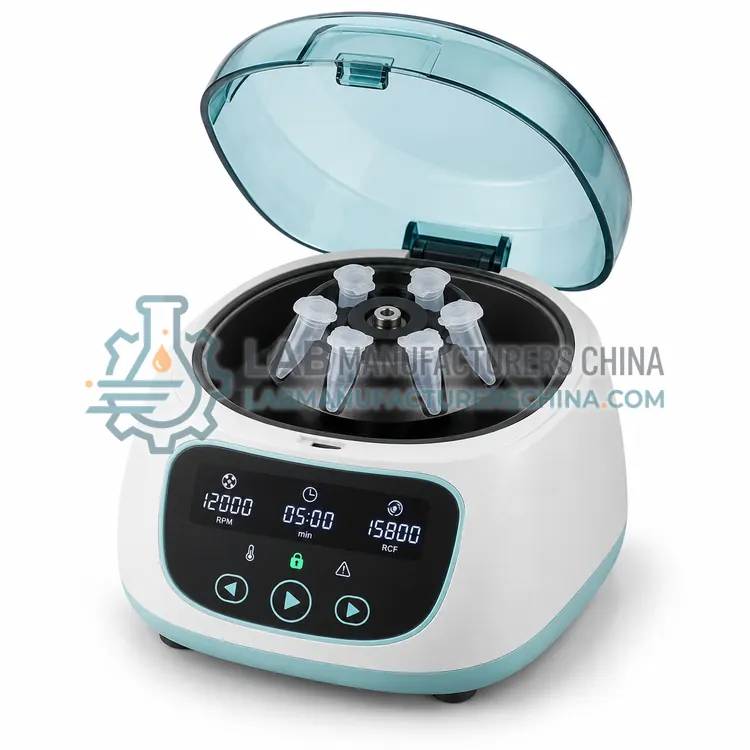
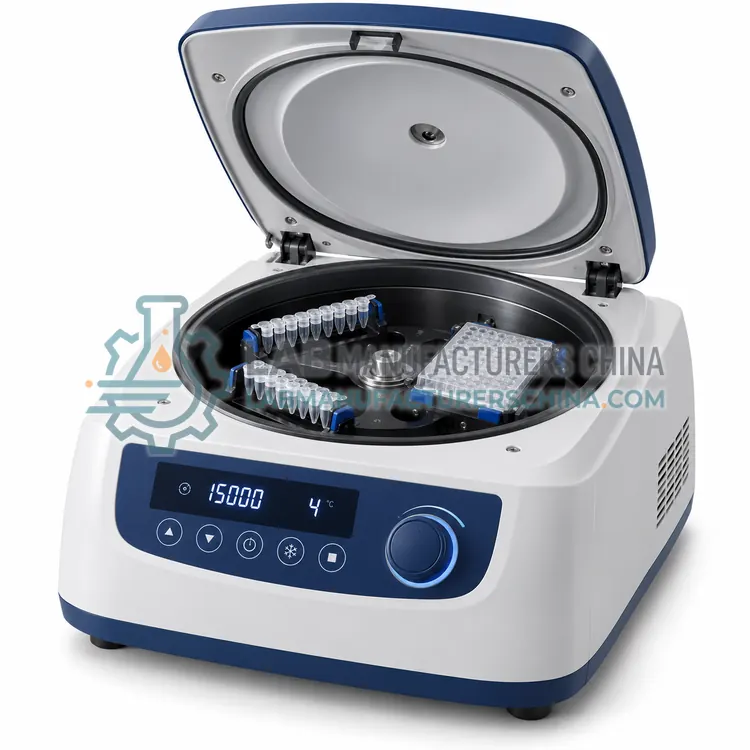
A high-speed microcentrifuge spins 24 x 1.5/2.0 mL tubes at up to 15,000 to 18,000 rpm, giving about 18,000 to 21,000 x g at ambient temperature. It is the standard bench unit for nucleic acid precipitation, protein work and spin-column steps requiring high RCF.
What is the High-Speed Microcentrifuge?
A high-speed microcentrifuge spins 24 x 1.5/2.0 mL tubes at up to 15,000 to 18,000 rpm, giving about 18,000 to 21,000 x g at ambient temperature. It is the standard bench unit for nucleic acid precipitation, protein work and spin-column steps requiring high RCF.
Overview
The high-speed microcentrifuge is the benchmark configuration for molecular biology laboratories. A brushless DC motor drives an aluminum fixed-angle rotor with 24 positions for 1.5 or 2.0 mL tubes, accelerating to maximum speed in 10 to 20 seconds and braking in about the same time. Speeds of 15,000 to 18,000 rpm produce 18,000 to 21,000 x g. The rotor has a screw-on or locking lid that is aerosol-tight, and adapters fit 0.2 mL and 0.5 mL tubes. A digital display shows speed, RCF and time, and a short-spin key provides pulse runs. Because there is no refrigeration, continuous runs beyond about 30 minutes at full speed can raise chamber temperature by 10 C or more. Weight is about 8 to 12 kg, and noise is typically 55 to 60 dB(A).
How does it work?
A microcentrifuge spins a small, lightweight rotor directly coupled to a brushless DC motor, reaching top speed in 10 to 30 seconds. Fixed-angle rotors hold tubes at 45 degrees, which shortens the sedimentation path and gives rapid pellet formation on the tube wall. The rotor is made of aluminum or engineering plastics and has a sealed lid option for biosafety. RCF equals 1.118 x 10^-5 times rotor radius in centimeters times rpm squared, and most models let the user enter either value. Short-spin or pulse functions run while a key is held. An imbalance sensor and lid lock stop the motor if the load is uneven or the lid opens. Refrigerated versions add a compact compressor. PCR strip rotors and colored tube adapters handle small sample formats.
What are the key features?
- 24-position rotor for 1.5 and 2.0 mL tubes with aerosol-tight lid
- Reaches maximum speed in 10 to 20 seconds with brushless DC drive
- Digital display of rpm, RCF and time with short-spin key
- Adapters for 0.2 mL and 0.5 mL tubes included or optional
- Imbalance detection and lid lock stop the rotor if loads are uneven
What are the technical specifications?
A typical high-speed microcentrifuge configuration offers maximum speed of 15,000–18,000 rpm, maximum RCF of 18,000–21,000 x g, rotor capacity of 24 x 1.5/2.0 mL, acceleration time of ≤ 20 s, braking time of ≤ 20 s and timer range of 10 s–99 min. Values are indicative of the product class; the exact figures for each configuration are confirmed on the quotation and the calibration documents supplied with the instrument.
Which applications is it used for?
The High-Speed Microcentrifuge is used in DNA and RNA precipitation, spin-column purification, protein sample clarification and cell lysate pelleting. Across the wider Microcentrifuges class, laboratories also deploy it for DNA and RNA spin-column purification, PCR tube pulse spins and protein precipitation.
Which standards and certifications apply?
Relevant standards and methods include IEC 61010-1, IEC 61010-2-020, IEC 61326-1, ISO 15189, CLSI MM13 and GB 4793.1. Certification candidates for this model are CE, ISO 9001 manufacturing and RoHS; each is to be confirmed for the specific configuration before shipment, and certificates are supplied only where they have been issued.
Keep the lid clean and free of residue, since dried sample or salts can cause rotor corrosion and imbalance. Wipe the chamber and rotor with 70 percent ethanol or mild detergent, and autoclave rotors only if rated. Tubes should be balanced in opposing positions, with matched volumes and tube types. Inspect the rotor for cracks, pitting or deformation at least every six months and retire it at the stated lifetime. Verify speed and timer annually with a tachometer. Keep aerosol-tight lids closed when handling pathogens. Place the unit on a flat bench away from edges, because vibration can cause walking during unbalanced runs.
How do I select the right High-Speed Microcentrifuge?
Select the high-speed ambient model for routine molecular biology when spins are short and samples are not temperature sensitive. It costs less than refrigerated siblings and is lighter, but it offers no temperature control. In the RFQ, specify RCF, rotor positions, lid type, timer range, adapters and voltage.
How does it compare with other Microcentrifuges variants?
Choose by RCF first: spin-column work typically needs 10,000 to 14,000 x g, while RNA and protein precipitation often calls for 12,000 to 21,000 x g. Decide whether refrigeration is necessary; ambient models suffice for DNA spin columns and quick spins, but RNA, enzymes and long spins benefit from 4 C. Rotor capacity matters, with 12, 24 and 30 tube positions common. Look for interchangeable rotors, aerosol-tight lids, PCR strip adapters, programmable timers, and quiet operation below 55 dB(A). For high-throughput settings, consider units accepting 96-well plates or PCR strips. Verify that tubes are rated for the RCF and confirm the unit is compact enough for shared benches and biosafety cabinets.
Full specifications
| Maximum speed | 15,000–18,000 rpm |
|---|---|
| Maximum RCF | 18,000–21,000 x g |
| Rotor capacity | 24 x 1.5/2.0 mL |
| Acceleration time | ≤ 20 s |
| Braking time | ≤ 20 s |
| Timer range | 10 s–99 min |
| Speed accuracy | ±20 rpm |
| Noise level | ≤ 60 dB(A) |
| Power supply | 220 V, 50/60 Hz, 150–250 W |
| Weight | approx. 8–12 kg |
Indicative values for this product class. Final specifications are confirmed on the quotation and in the calibration documents supplied with the instrument.
Applications
- DNA and RNA precipitation
- Spin-column purification
- Protein sample clarification
- Cell lysate pelleting
Key features
- 24-position rotor for 1.5 and 2.0 mL tubes with aerosol-tight lid
- Reaches maximum speed in 10 to 20 seconds with brushless DC drive
- Digital display of rpm, RCF and time with short-spin key
- Adapters for 0.2 mL and 0.5 mL tubes included or optional
- Imbalance detection and lid lock stop the rotor if loads are uneven
Frequently asked questions about High-Speed Microcentrifuge
Short spins of 1 to 15 minutes cause only slight warming. Runs of 30 minutes or more at full speed can raise chamber temperature by 10 C or more, which may harm sensitive samples. For long spins use a refrigerated model or reduce speed.
They describe the same instrument from different perspectives. Rpm is rotor speed, while x g is force. A rotor with radius 8.4 cm at 15,000 rpm yields about 21,000 x g. A different rotor radius changes x g at the same rpm.
Only if the tube is rated for that force. Many 2.0 mL safe-lock tubes are rated to 15,000 to 20,000 x g, but screw-cap and thin-walled tubes may be rated lower. Check the tube manufacturer's specification before using top speed.
General-purpose microcentrifuges typically reach 12,000 to 15,000 rpm, equal to about 13,000 to 18,000 x g. High-speed models exceed 21,000 x g at 15,000 to 18,000 rpm. Mini centrifuges for pulse spins reach only 2,000 to 6,000 rpm, or about 2,000 to 6,000 x g.
Refrigeration is needed for temperature-sensitive work such as RNA precipitation, protein extraction, enzyme assays and co-immunoprecipitation, where spins last 10 minutes or more at high RCF. For DNA spin columns and quick spins, ambient models are generally sufficient.
Yes, with adapters for 0.2 mL tubes and 8-strip PCR formats, or with dedicated PCR rotors. Mini centrifuges often include interchangeable rotors for 1.5 mL tubes and 0.2 mL strips, enabling quick collection of droplets from lids before pipetting.
Related models