Class A Volumetric Pipette
A 级容量移液管
- SKU GLA-0002
- Glassware
- CE (to be confirmed)
- ISO 9001 manufacturing (to be confirmed)
Price on request — FOB / CIF quoted per order
Prices depend on configuration, quantity and destination port.
Key specifications
| Class | Class A |
|---|---|
| Material | Borosilicate 3.3 |
| Volume range | 0.5–100 mL |
| Tolerance | ± 0.01 to ± 0.05 mL |
| Calibration temperature | 20 °C |
| Drainage time | ≈ 15 s |
Request a quote Download brochure · to be provided
By Lab Manufacturers China Technical TeamLast reviewed Standards: ISO 3585 (borosilicate glass 3.3), ISO 1042 (one-mark volumetric flasks), ISO 385 (burettes)
What is the Class A Volumetric Pipette?
A Class A volumetric pipette delivers a single calibrated volume with a tight tolerance. It is used for accurate transfer of standards, reagents and samples in volumetric analysis with a specified drainage time.
What is the Class A Volumetric Pipette?
A Class A volumetric pipette delivers a single calibrated volume with a tight tolerance. It is used for accurate transfer of standards, reagents and samples in volumetric analysis with a specified drainage time.
Overview
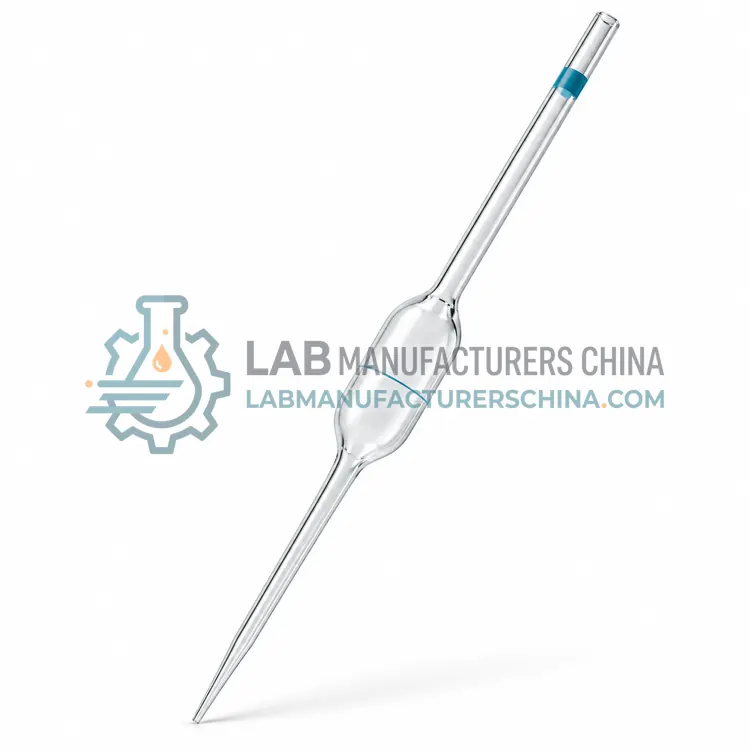
The pipette is a borosilicate 3.3 tube with a central bulb, a single graduation mark above the bulb and a tapered delivery tip. It is calibrated to deliver a stated volume at 20 °C after free drainage, with tolerances following ISO 648, for example about ± 0.01 mL at 2 mL and ± 0.05 mL at 50 mL. Volumes range from 0.5 mL to 100 mL. The last drop is not blown out unless the pipette is marked to do so, and drainage time is specified, commonly 15 seconds, because it affects the delivered volume. Transfer pipettes and bulb pipettes both exist, and pipettes may be certified individually. A pipette filler, not the mouth, is used to draw liquid, and the tip must be clean and undamaged to deliver the calibrated volume.
How does it work?
Laboratory glassware works because borosilicate 3.3 is chemically inert, transparent and resistant to heat and thermal shock. Its low coefficient of expansion, about 3.3 × 10⁻⁶ per kelvin, means it tolerates rapid temperature change without cracking, and it resists attack by most acids, solvents and reagents, so it does not contaminate samples or react with them. Volumetric glassware carries a calibration mark and is made to defined tolerances: Class A flasks and pipettes hold or deliver a stated volume at 20 °C within a tight limit, while Class B allows a wider tolerance for less critical work. Graduations on cylinders and beakers are approximate. Ground joints and stoppers seal by friction, and standard tapers allow interchange. Because glass is brittle, care is needed with impact and with hydrofluoric acid and hot alkalis, which attack it.
What are the key features?
- Central bulb with single mark
- Calibrated to deliver at 20 °C
- Tolerance ± 0.01 to ± 0.05 mL
- Volumes 0.5–100 mL
- Specified drainage time of 15 s
- Individual certification option
What are the technical specifications?
A typical class a volumetric pipette configuration offers class of Class A, material of Borosilicate 3.3, volume range of 0.5–100 mL, tolerance of ± 0.01 to ± 0.05 mL, calibration temperature of 20 °C and drainage time of ≈ 15 s. Values are indicative of the product class; the exact figures for each configuration are confirmed on the quotation and the calibration documents supplied with the instrument.
Which applications is it used for?
The Class A Volumetric Pipette is used in standard transfer, titration, accurate reagent addition and volumetric sample transfer. Across the wider Glassware class, laboratories also deploy it for standard and reagent preparation, titration and volumetric analysis and sample mixing and heating.
Which standards and certifications apply?
Relevant standards and methods include ISO 3585 (borosilicate glass 3.3), ISO 1042 (one-mark volumetric flasks), ISO 385 (burettes), ISO 4788 (graduated measuring cylinders), ASTM E438 (glass composition) and USP <660> (glass containers). Certification candidates for this model are CE and ISO 9001 manufacturing; each is to be confirmed for the specific configuration before shipment, and certificates are supplied only where they have been issued.
Clean glassware thoroughly, using a detergent suited to the residue and rinsing with reagent water, since residual detergent or acid affects results. Avoid abrasives and strong alkalis that etch glass and remove graduation marks, and never use hydrofluoric acid in glass. Dry volumetric glassware by air or with solvent rather than heat, because heating changes the calibrated volume. Handle ground joints carefully, store stoppers loosely or with a spacer and avoid seizing by keeping joints clean. Check for chips, cracks and star cracks before use, since damaged glassware can fail under vacuum or heat. Keep the calibration certificate and recheck or replace volumetric items that are damaged or of unknown history.
How do I select the right Class A Volumetric Pipette?
Choose a volumetric pipette where a single accurate volume must be delivered, and size it close to the volume needed. Confirm tolerance and drainage time. RFQ: volumes, tolerance, certificate and filler needs. Provide the volumes and tolerance needed.
How does it compare with other Glassware variants?
Choose the item by function and accuracy. Use Class A volumetric flasks and pipettes where the volume must be accurate, for standards, dilutions and titrations, and Class B or graduated items for approximate work. Select the material for the chemistry: borosilicate 3.3 for general laboratory use, and avoid glass for hydrofluoric acid, hot concentrated alkali and some fluoride-containing reagents, where plastic is safer. Match capacity and neck size to the application, and use narrow-neck flasks for mixing and wide-neck for solids. Check that graduations are legible and durable when buying, and confirm the calibration certificate for volumetric items. Consider whether low-extractable or amber glass is needed for light-sensitive or trace work, and plan cleaning and drying that will not damage the marks.
Full specifications
| Class | Class A |
|---|---|
| Material | Borosilicate 3.3 |
| Volume range | 0.5–100 mL |
| Tolerance | ± 0.01 to ± 0.05 mL |
| Calibration temperature | 20 °C |
| Drainage time | ≈ 15 s |
| Delivery | To deliver, free drainage |
| Type | Bulb or transfer |
| Certificate | Individual option |
| Standard | ISO 648 |
Indicative values for this product class. Final specifications are confirmed on the quotation and in the calibration documents supplied with the instrument.
Applications
- Standard transfer
- Titration
- Accurate reagent addition
- Volumetric sample transfer
Key features
- Central bulb with single mark
- Calibrated to deliver at 20 °C
- Tolerance ± 0.01 to ± 0.05 mL
- Volumes 0.5–100 mL
- Specified drainage time of 15 s
- Individual certification option
Frequently asked questions about Class A Volumetric Pipette
Only if the pipette is marked to deliver by blowing out, usually with two rings or the word blow-out. Standard volumetric pipettes are calibrated for free drainage, so the residual drop is part of the design.
Because the film of liquid left on the wall drains slowly, and the delivered volume depends on how long you wait. Standard times, commonly 15 seconds, make results reproducible between users.
No. A pipette filler or bulb should always be used, because mouth pipetting risks ingestion of hazardous substances and cannot control the aspirated volume accurately.
Class A volumetric glassware is calibrated to tighter tolerances and is used for standards, dilutions and titrations. Class B allows a wider tolerance and suits less critical work where absolute accuracy is not required.
It is chemically inert, transparent and resistant to heat and thermal shock, with a low expansion coefficient, so it can be heated, cooled and cleaned repeatedly without cracking or contaminating samples.
No. Hydrofluoric acid attacks glass, so it must be handled in polypropylene, PTFE or other resistant plastic. Hot concentrated alkali also attacks glass and should be avoided.
Related models